


 For all latest news, follow the Daily Sun's Google News channel.


Rise of Starbucks: From coffee bean seller to global coffee giant
USA Today, Washington
Published: 15 Jul 2026, 12:35 PM
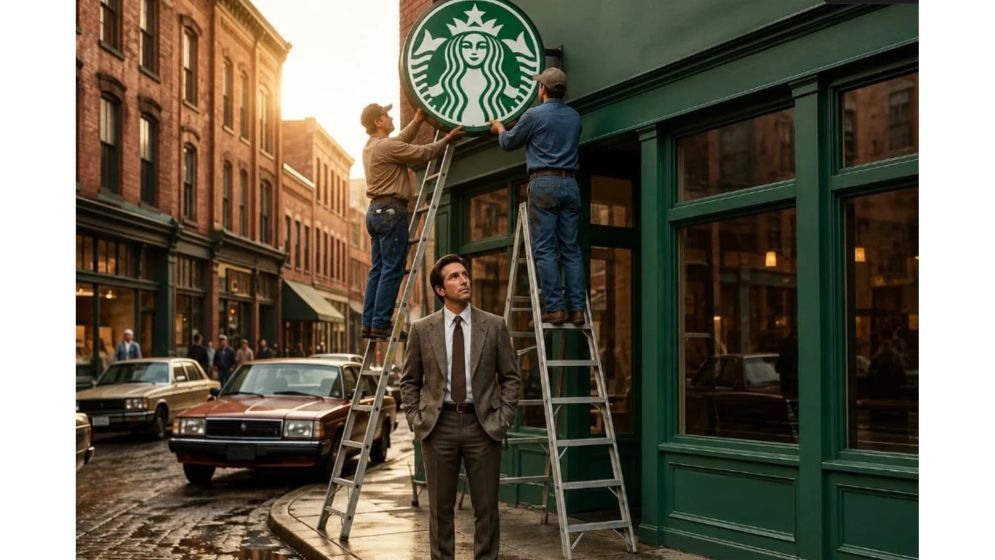
Rise of Starbucks: From coffee bean seller to global coffee giant-Photo: Collected
A venti macchiato. Pistachio cold foam. Almond milk. Iced, please. And, sure, throw a little whipped cream on top.
The espresso machine thrums like an engine. Dark coffee beans tumble through grinders. That smell of Sumatra — earthy, smoky, almost hypnotic.
Behind the bar, green-aproned baristas slide cups down the counter, scribble names in black marker and call out orders for the next Starbucks pickup.
Rise of Starbucks Starbucks' iconic cups, stamped with the two-tailed siren logo, appear everywhere: on commuter trains, in airport terminals, in paparazzi photos, in a medieval feast scene on HBO’s “Game of Thrones” (accidentally, of course).
Today, the global coffee giant operates over 40,000 stores in more than 80 countries, a global retail empire with a market cap topping $110 billion.
But it wasn’t always this way.
“I mean, people would’ve thought you’d lost your mind,” historian Bryant Simon said of the idea that Americans would one day pay several dollars for elaborate espresso drinks.
For much of the 20th century, coffee in the United States was cheap and almost forgettable, either instant granules dissolved in hot water or weak brews coaxed from percolators.
“It is hard to exaggerate how bad American coffee was,” Simon said. “It was just there. It was an industrial product, pre-made, pre-ground, not a ton of concern about the quality of the coffee beans.”
Then came Starbucks, a company many historians agree upgraded the staple and, with it, quietly reshaped how Americans viewed themselves and how they moved through their cities and lives.
“It’s hard to find an example of a company that has had that kind of impact not only on coffee, but on the culture of how we consume a product,” said Chris Kayes, professor of management and department chair at The George Washington University School of Business.
The story begins in 1971, inside Seattle’s Pike Place Market, a famous crowded stretch of storefronts overlooking Elliott Bay.
There, three college friends — Jerry Baldwin, Zev Siegl and Gordon Bowker — opened a small store selling high-quality coffee beans, loose tea and spices, scooped into paper bags for customers to brew at home. Espresso drinks were not part of the menu.
The founders named the company after Starbuck, the first mate in the classic novel "Moby-Dick," and paired it with a siren, a nod to Pacific Northwest maritime culture.
For its first decade, the business remained small and local, opening a handful of additional stores around Seattle and focusing entirely on selling quality arabica beans.
“Americans didn’t really know what high-end coffee was,” Kayes said. “For the most part, people were consuming robusta beans, which are really mass-produced coffee and not as good as arabica.”
Simon, author of "Everything But the Coffee: Learning About America from Starbucks," said that made coffee a generic product that was “ripe for upgrade.”
That upgrade began almost by accident.
In 1981, a young Xerox salesman named Howard Schultz flew to Seattle to investigate an unusual customer: a small Washington retailer ordering far more drip coffee machines than expected.
Curious, he traveled west and stumbled into the original Starbucks location.
The experience captivated him. Within a year, he had begged and eventually persuaded the founders to hire him, joining global coffee giant Starbucks in 1982 as director of operations and marketing.
Schultz believed the small Seattle coffee shop held enormous potential. But the idea that would transform Starbucks did not come from Seattle — it came from Italy.
In 1983, Schultz traveled to Milan on a buying trip. What he encountered there, he said, reshaped his understanding of coffee entirely.
“I discovered the ritual and the romance of coffee bars in Italy,” Schultz wrote in his 1997 memoir "Pour Your Heart Into It: How Starbucks Built a Company One Cup at a Time."
“Each one had its own unique character, but there was one common thread: the camaraderie between the customers and the barista," Schultz wrote.
Watching the ritual unfold, Schultz had an “epiphany.”
“Starbucks had missed the point — completely missed it. This is so powerful, I thought. This is the link,” he wrote. “The Italians had turned the drinking of coffee into a symphony, and it felt right. Starbucks was playing in the same hall, but we were playing without a string section.”
When Schultz returned to Seattle, he decided instead of simply selling beans, Starbucks should recreate the Italian coffee bar experience in the United States.
Kayes said Schultz was essentially trying to import a social institution that did not yet exist in the United States.
“He’s probably thinking about these large piazzas in Europe and people drinking in 200-year-old coffee houses,” Kayes said. “You get to America, and we don’t have places like that.”
So Schultz imagined something new.
“He comes up with this idea to build these really cozy spaces,” Kayes said. “Now you have this kind of environment where you have a cozy European space, but it’s very Americanized.”
In April 1984, Starbucks, a global coffee giant, opened its sixth store in Seattle. Schultz was given a corner of the shop to introduce espresso drinks.
Office workers wandered in that morning to find a menu filled with unfamiliar words: latte, cappuccino, macchiato. By the end of the day, about 400 customers had passed through the store — nearly double the normal traffic for a Starbucks location at the time.
The genie was out of the bottle.
“From the minute we opened, this much was clear to me: the global coffee giant Starbucks had entered a different business,” Schultz wrote. “There could be no turning back.”
A cultural phenomenon
What followed was one of the most aggressive growth stories in modern retail. Schultz bought the company along with a group of investors in 1987 and pushed rapid expansion through the 1990s.
“Starbucks was one of the early companies that embraced growth at all costs — ‘we’ll forego profits, we’ll forego anything just to increase revenue,’” Kayes said.
By 1996, the company had gone public and opened roughly 1,000 locations, including its first store outside North America, in Japan.
Three years later, it passed 2,000 stores. By the mid-2000s, Starbucks had spread across thousands of American cities and suburbs.
The company now generates tens of billions of dollars in annual revenue, with a massive global real estate footprint and a supply chain sourcing coffee from more than 30 countries and over 400,000 farmers.
“At first, we figured it was simply because of the coffee,” Schultz wrote in his memoir. “But as time went on, we realized that our stores had a deeper resonance and were offering benefits as seductive as the coffee itself.”
Part of the appeal was Seattle. In the 1990s, the city was suddenly everywhere in popular culture. Grunge bands like Nirvana and Pearl Jam were dominating radio. Films like "Sleepless in Seattle" romanticized its moody, rain-soaked atmosphere. Starbucks became part of that cultural moment.
Inside the stores, Starbucks leaned into wood tones, soft lighting and jazz or world music.
Starbucks also sold a place people could identify with.
“We lived in a fragmented time when Starbucks was coming up,” said Joseph Michelli, a psychologist and fan of Schultz who wrote "The Starbucks Experience: 5 Principles for Turning Ordinary Into Extraordinary."
“The notion of creating a place where people could come and have community, I think, was pretty revolutionary," Michelli said.
That idea, he said, reshaped how Americans used public spaces. Groups pushed tables together. People met for low-stakes first dates. Deals were being brokered over coffee.
Sociologists sometimes refer to those kinds of spaces as "third places," somewhere between home and work where people gather informally. Schultz embraced the concept.
Simon said the effect went far beyond caffeine.
"It begins to rewrite the way we organize space and time,” he said. “It changed where we studied. It changed how we worked. It changed where we met people."
The stores also became a subtle form of social signaling. Simon said Starbucks offered what he called a "bohemian bourgeois sensibility."
Ordering a latte or macchiato carried a cultural meaning. The cup itself became part of the message.
Starbucks also produced cultural icons along the way: Red holiday cups. Frappuccinos. The pumpkin spice latte, introduced in 2003, became synonymous with fall. And in 2025, the Bearista cup caused a craze, with customers lining up overnight and, in some cases, brawling over it.
"As a brand, I don't think the global coffee giant set out to reshape culture," Tressie Lieberman, Starbucks' global chief brand officer, told USA TODAY. "Over time, these moments that were so beautifully orchestrated around craft, connection and personalization really redefined how Americans engage with coffee, how we build community.”
At the center of that idea is the coffeehouse experience.
“The third place is the soul,” Lieberman said. “We created that for America. We created it because Howard went to Milan and saw that experience and brought it here.”
Many experts agree Starbucks created an industry that did not exist and today, independent cafés and competing chains have sprouted worldwide. Though Starbucks remains the biggest seller of coffee, it's facing more competition. Starbucks' share of spending at U.S. coffee shops was 48% in 2024 and 2025, down from 52% in 2023, according to Technomic, a food industry consulting firm.
Losing its way
For much of its history, Starbucks wrestled with a paradox: the very success that built the company also made it vulnerable.
By the late 2000s, years of breakneck growth had pushed the chain into nearly every corner of the country. Then came the global financial crisis of 2008.
Starbucks’ stock price plunged by more than 50% that year, and Schultz returned as chief executive after stepping aside earlier in the decade.
The company stabilized financially, but deeper questions have now emerged inside the stores themselves.
“Starbucks has lost its way in a couple of different paths,” Kayes said. “They didn’t keep up their physical environment, and the service became inconsistent.”
Menu expansion was one of the biggest changes. Over the years, Starbucks introduced an ever-growing list of beverages and customizations. The strategy helped drive revenue, but complicated life behind the counter.
“These were difficult drinks to make, time-consuming, and often came out incorrect,” Kayes said. “I once waited 20 minutes for my drink, and it ended up never coming, and I just left.”
The sensory experience inside stores also drifted from the original coffeehouse vision.
“For a while, they were serving breakfast foods that were putting off a burnt smell that was overpowering the smell of coffee,” Michelli said.
The company also faces a changing coffee market as competitors grow and eat into Starbucks’ market share.
“Americans haven’t fallen out of love with Starbucks,” Kayes said. “They’ve just become polyamorous in the sense that they love their coffee from different places now.”
Business pressures of scale continued to push Starbucks toward speed and convenience, and technology accelerated that shift.
Starbucks became one of the first major retailers to build a mobile payment and ordering platform. Customers could load money into the app and order remotely. Analysts note that if app and gift card balances were treated like deposits, Starbucks would rank in the top 10% of U.S. banks by deposit size.
That shift toward speed and efficiency proved successful and is now visible across the entire coffee industry.
A record 59% of coffee purchases now happen at drive-thru windows, according to the National Coffee Association. Starbucks leaned heavily into the trend, especially after the pandemic, building new drive-thru locations and encouraging mobile pickup.
But Schultz later acknowledged speed also changed the rhythm of the coffeehouse.
“It was beginning to deteriorate at a rapid rate, the third place experience and the sense of community,” Schultz said on the Acquired podcast in 2024. “Everyone shows up and all of a sudden we’ve got a mosh pit, and that’s not Starbucks.”
Starbucks also built its reputation around a different promise: that it would treat its employees better, becoming one of the first major chains to offer health care to part-time workers.
But the labor environment began to shift dramatically during and after the COVID-19 pandemic.
In December 2021, baristas at a Buffalo, New York, Starbucks voted to form the first union at a company-owned Starbucks store in the United States. The organizing effort quickly spread nationwide.
By early 2026, more than 650 Starbucks stores across 45 states had unionized. The brand had become synonymous with a new wave of labor organization.
“They were caught off guard and swept up in the post-pandemic movement where labor felt empowered during what was called the Great Resignation,” Kayes said. “When all of a sudden you’ve got competition for scarce labor, that changed pretty quickly.”
Simon said recent labor tensions highlight a long-running contradiction in Starbucks’ identity.
“Those desires that it trumpeted, that it cared about, were compromised at any moment that profit was at stake,” Simon said. “And I understand that it is the duty of a CEO and executives, not to support the community, but to support shareholders, but that is not the way Starbucks positioned itself.”
As one example, Simon pointed to Schultz’s handling of the Seattle SuperSonics. In 2001, Schultz led a group of investors that bought the NBA team and promised to keep it in Seattle. But after efforts to secure public funding for a new arena failed, he sold the franchise in 2006 to a group that later relocated it to Oklahoma City.
“In a very Starbucks way, Schultz would screw Seattle, stab it in the back,” Simon said. “That identification meant only so much, and when there was a chance to make money on the SuperSonics, he sold them.”
Schultz later expressed regret over the decision.
In his book "From the Ground Up," he wrote: “Selling the Sonics as I did is one of the biggest regrets of my professional life. I should have been willing to lose money until a local buyer emerged. I am forever sorry.”
New effort: 'Back to Starbucks'
In recent years, Starbucks executives have begun trying to steer the company back to what once defined its success.
The current strategy, known as “Back to Starbucks” and pushed by new CEO Brian Niccol, aims to reemphasize hospitality and the in-store experience.
The company has committed roughly $500 million to store renovations and service improvements, including adding more than 25,000 café seats across the U.S. by the end of 2026.
Lieberman said the strategy is Starbucks "unlocking our superpowers," which are rooted in three elements.
“Going back to what made Starbucks, Starbucks: coffee, craft and connection, and making sure we do all of those exceptionally well,” she said. “We’re not a brand that is just transactional. We are a brand that is about experience.”
But she said the company’s larger focus is cultural, building on a “beloved platform.”
“I can think of very few brands that have created as many iconic platforms and iconic moments as Starbucks,” Lieberman said. “When we look through the lens of what our strengths are, we're not just chasing trends. We're creating things that are uniquely Starbucks.”
As Starbucks looks toward the future, more cultural moments loom.
The United States will celebrate its 250th anniversary in 2026, and Lieberman said Starbucks is considering marking the occasion the way it always has: through small rituals tied to its customers, like seasonal drinks or limited-time products.