


 For all latest news, follow the Daily Sun's Google News channel.


Deadly Iran wedding strike likely due to US bomb missing a nearby target
Six weapons dropped by Navy jets targeted a communications complex in the coastal town of Kuhestak; one missed
The Washington Post
Published: 07 Sep 2026, 02:55 AM
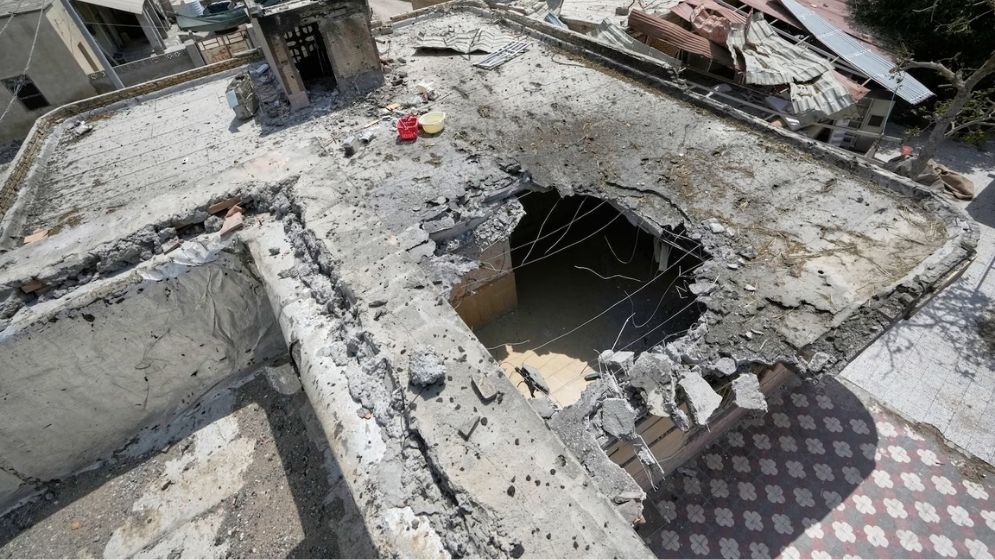
The point of impact on the roof of a building where a wedding celebration was taking place on Tuesday. Photo: AP
The Pentagon is investigating the high likelihood that an explosion in southern Iran that destroyed a home hosting a wedding celebration was caused by a US bomb that missed a nearby target, a person familiar with the operation said.
The strike on the home, which Iranian
officials said killed at least four civilians and injured dozens more, was part
of a larger wave of attacks on Tuesday in southern Iran, described by US
officials as retaliation for increased threats to US troops and commercial
shipping.
US forces launched an airstrike in the
coastal town of Kuhestak that targeted a communications complex, a US official
said. The complex, which included a small building at its base, sat in a
civilian area but was believed to be utilized in part by Iranian forces to
conduct operations, the person familiar said.
Six bombs dropped by US Navy jets traveled on
a tight pathway toward the tower and all struck the site except for one, which
appeared to go astray, said the person, who like others spoke on the condition
of anonymity to discuss sensitive operations.
An explosion tore into the roof of the home
approximately 440 feet from the tower, according to visuals verified by The
Washington Post.
The explosion killed at least two women and
two children aged 4 and 16 years old, according to Ali Jafarian, Iran’s deputy
health minister, and injured more than 90 others. The Post could not independently
verify those figures.
The mishap followed an exhaustive targeting
process, which include US personnel working to minimize harm to civilians, the
person familiar said, like multiple layers of verifying target locations.
“We’re investigating it because obviously we
care. We want to know,” Vice President JD Vance said when asked about the
strike in a news conference Thursday.
Central Command, which oversees military
operations in the area, said it was aware of reports of civilian casualties and
is “looking into them” but declined to provide additional details.
“The US military never targets civilians,
unlike the IRGC,” said Navy Capt. Tim Hawkins, a spokesman for Central Command,
using the acronym for Iran’s paramilitary Revolutionary Guard.
Officials are assessing one other possibility
for the explosion at the home, including an air defense missile falling out of
the sky — a circumstance the person familiar and weapons experts independently
said was highly unlikely.
The tower was the only target slated for
attack in Kuhestak, the person familiar said, ruling out a scenario that the
home was intentionally struck or was mixed up with some other target.
The Post verified photographs and video from
the night of the attack and aftermath published on social media to determine locations
and precise distances.
Details of the strike were earlier reported
by the New York Times and Reuters.
The bombing is among a growing list of US
strikes that have killed civilians during the six-month conflict, which has
entered a tenuous ceasefire marked by occasional attacks.
The Trump administration has dismissed
concerns raised by lawmakers and human rights groups that have alleged
airstrikes without due regard for civilians nearby are violations of
international law. The Pentagon has mostly dismantled an office focused on
mitigating civilian harm and reassigned personnel who investigate such
incidents.
An airstrike on an Iranian military compound
in the early hours of the war in February struck a nearby school, killing at
least 175 people, many of them children, according to Iranian state media. That
strike was the result of an error that involved outdated targeting information,
The Post previously reported.
Video posted by the Iranian Red Crescent
Society from the night of the wedding attack showed people with flashlights
rushing into the damaged buildings, and emergency workers appearing to use a
hose to douse fires.
“In the new list of war crimes and attacks by
the US army on civilian targets in Iran, after schools, stadiums, and
residential homes, now add wedding ceremonies to this list too...,” the Iranian
Red Crescent Society wrote on X.
It is unclear why the bomb in Tuesday’s
strike did not hit its intended target. Guided munitions rely on several
precise capabilities, including GPS coordinates, and almost always strike their
intended targets, munition experts have said. Errant strikes are rare and
typically the result of flawed intelligence, human error or malfunctions on the
weapon itself.
The munitions used to target the tower
complex were US glide bombs known as Joint Standoff Weapons, or JSOW, the
person familiar with the incident said.
Images from an Iranian state news channel
showed strike remnants that were consistent with the JSOW’s tail fin and
casing, said Trevor Ball, a weapons technical analyst for Armament Research
Services who served as an Army explosive ordnance disposal technician. The Post
was not able to independently verify the pieces were recovered from the site.
The damage seen is consistent with a variant
of JSOW that uses two warheads with about 193 pounds of explosives inside, Ball
said. The uniform shape of the crater, plus a spread of fragmentation on the
structure and nearby buildings, showed a munition that detonated directly on
the roof or exploded right above it, he said.
He ruled out other possibilities for the
damage, like an Iranian air defense missile falling onto the home or a weapons
depot exploding nearby, because the damage and shrapnel marks would have appeared
significantly different.
The JSOW can be manually updated on its way
to a target and it is possible they missed by aiming for a narrow segment of
the tower, said Mark Cancian, a senior adviser with the Center for Strategic
and International Studies think tank.
It is unlikely that electronic jamming or
some other interference would alone be sufficient to disrupt the trajectory of
a JSOW, which have complementary guidance systems, Cancian said. He said it was
“highly likely” the strikes at the tower and home were conducted by US forces
after reviewing imagery and other details.
Wes Bryant, who previously served as a
targeter in Air Force Special Operations, said military planners are obliged to
consider the immediate area when attacking in a populated area.
“Civilian pattern of life should be
established prior to attack, and every structure adjacent to the targeted
structure should be characterized,” said Bryant, who later served in the
Pentagon office focused on mitigating harm to noncombatants.