


 For all latest news, follow the Daily Sun's Google News channel.


BRICS agrees on joint declaration, bridging Iran-UAE gap over war
Reuters, New Delhi
Published: 12 Sep 2026, 04:39 PM
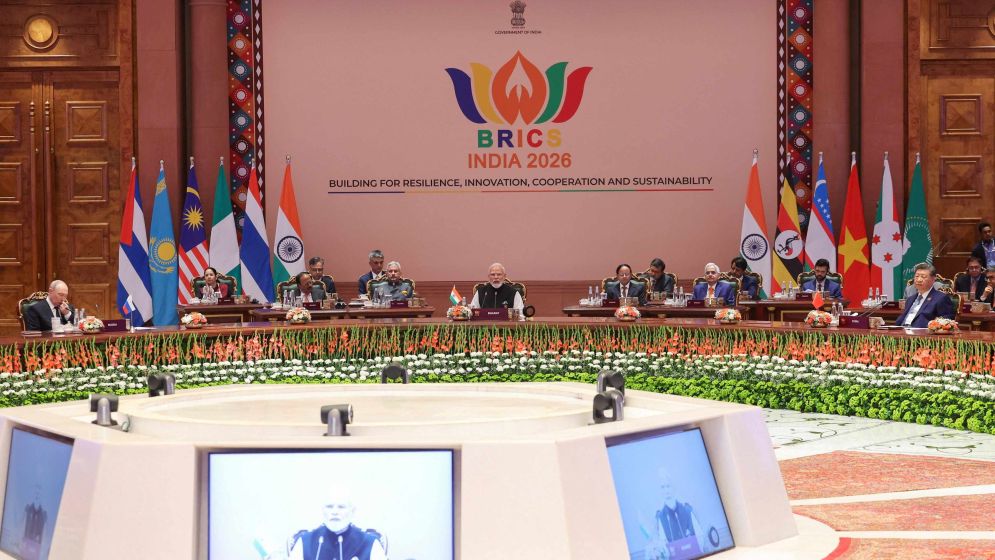
India's Prime Minister Narendra Modi speaks on the day of the BRICS Summit in New Delhi, India, 12 September 2026. Photo: India's Ministry of External Affairs
The BRICS group of emerging economies has agreed on a joint
declaration, sources told Reuters on Saturday, hours before its leaders began a
summit in New Delhi, aiming to boost the bloc's global clout.
The summit, hoping to bridge divisions between members Iran
and the United Arab Emirates over the Gulf conflict, is being held as the
United States and Iran resume tit-for-tat strikes in their six-month-old war.
That followed a pause in fighting for much of August, while
the Iran-aligned Houthi rebels in Yemen tightened their grip in the Red Sea
region.
Negotiators had agreed on a joint declaration unlikely to name any country but which will condemn unilateral war by any country, four sources told Reuters, adding that the bloc's leaders were expected to approve the document later on Saturday.
The foreign ministry of host India did not immediately
respond to a request for comment on the declaration.
Foreign policy experts had said the key test for the bloc
would be finding language on the Middle East crisis that both Abu Dhabi and
Tehran could accept, clearing the way for a joint declaration.
Such a joint statement was unlikely to influence the current
geopolitical landscape, but would demonstrate unity by a grouping of emerging
nations against economically debilitating policies such as Western sanctions,
they said.
BRICS foreign ministers meeting in New Delhi in May were
unable to issue a joint statement, stymied by differences between Iran and the
UAE.
Bloc seeks to raise international profile
The BRICS bloc is seeking to raise its profile by
influencing international rules and demanding the reform of institutions such
as the World Bank, IMF and WTO, which some members view as being dominated by
Western powers.
Leaders attending the summit are Russian President Vladimir
Putin, China's Xi Jinping, Iran's Masoud Pezeshkian, South Africa's Cyril
Ramaphosa and Abu Dhabi Crown Prince Sheikh Khaled bin Mohamed bin Zayed Al
Nahyan, among others.
New Delhi, which has strong ties with the United States,
Russia, Israel, Iran and the Gulf Arab states is engaged in a diplomatic
balancing act, with Prime Minister Narendra Modi pushing BRICS members to boost
trade cooperation, reduce barriers, and expand business opportunities.
The need to bridge the Iran-UAE divide over the US-Israeli
war on Iran and produce a consensus summit declaration, however, has been an
immediate concern for BRICS diplomats and officials.
UAE, after being hit by Iranian missiles since the war
began, suspended all trade and financial transactions with Iran in August.
BRICS groups Brazil, Russia, India, China and South Africa,
Egypt, Ethiopia, Indonesia, Iran and the United Arab Emirates.
It was set up in 2009 to challenge a world order dominated by the United States and its Western allies. Together, its members account for more than 40% of the world's population and almost a quarter of the global economy.