


 For all latest news, follow the Daily Sun's Google News channel.


French policing under scrutiny as student protest injuries mount
Reuters, Paris
Published: 10 Oct 2026, 04:22 PM
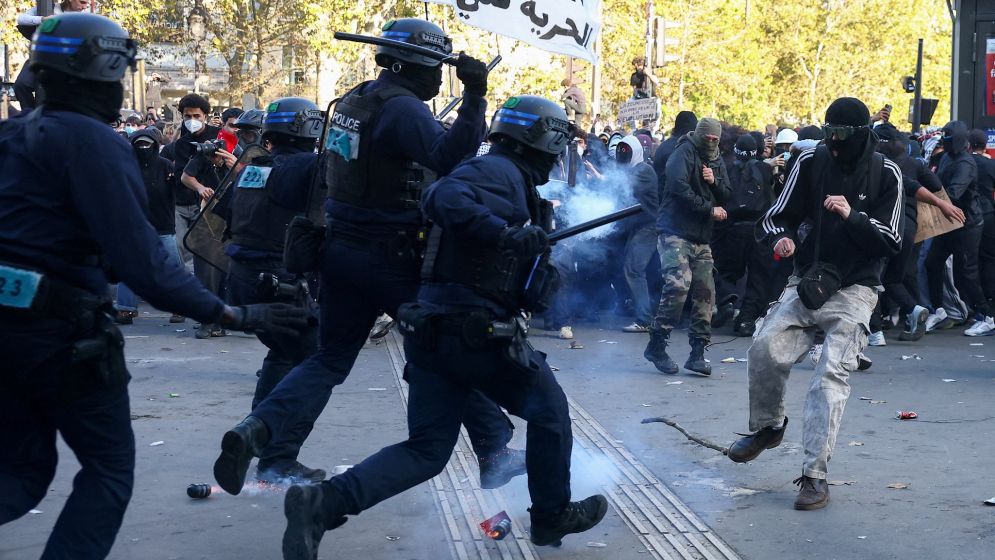
Police officers in riot gear run towards a demonstrator amid clashes during nationwide protests in Paris, France, 8 October 2026, to demand better school conditions. Photo: REUTERS
Fourteen-year-old Eden suffered a broken jaw and multiple
smashed teeth when he was struck by a tear gas canister directed towards him at
close range by a police officer last week during student protests in France,
his parents and family lawyer said.
The teenager had been sitting on a wall looking at his phone
metres away from the protest in Saint-Ouen-l'Aumone, the lawyer said. An
officer approached him and struck him with a baton, prompting Eden to respond
with a kick, according to the local prosecutor. A second officer then fired a
tear gas grenade with a Cougar launcher, hitting him in the face.
"(The officer) shot him in the mouth and left him lying on the ground, without even calling the emergency services," said lawyer Elsa Marcel. The family, who asked for Eden's second name to be withheld to protect their privacy, has filed a complaint for attempted murder, she said.
A police spokesperson said they do not comment on ongoing
investigations. The prosecutor's office said in a statement that the student
had confronted the police and the officers tried to push him back. The officer
was placed under formal investigation on charges of assault by a public
official resulting in permanent disability or disfigurement on Tuesday, eight
days after the incident.
The case is one of 24 under investigation by the IGPN
internal police watchdog linked to the policing of a more-than-two-week-long
wave of student unrest over conditions in schools. Prime Minister Sebastien
Lecornu has described the demonstrations as the most violent in decades.
The police response has renewed calls for the withdrawal of
the use of rubber bullets and grenade launchers, which are not used by police
in many other European countries and have been repeatedly criticised in recent
years by rights groups, including Amnesty International and UN human rights
experts, as dangerous and disproportionate.
It has also sparked anger among the public and fanned
support for a protest movement that is the latest manifestation of deep-seated
discontent with President Emmanuel Macron’s government ahead of a 2027
election.
Via interviews and reviews of legal documents, Reuters has
documented 28 cases of injuries suffered due to police force, of which 15 are
among those under investigation by the IGPN. They involve the use of rubber
bullets, stun grenades, tear gas, batons and charges on horseback.
In two cases, a person's eye has been lost or injured due to
rubber bullets. In another, a 15-year-old in Lens had his hand blown off —
likely by a stun grenade, according to interior minister Laurent Nunez, who
paused the use of stun grenades pending an investigation into the case.
Nunez said on Wednesday in a radio interview that about 200
students had been injured, but that it was very rarely the result of police
action. “Our primary role is, of course, to protect high school students,” he
said.
Authorities said that 700 police officers have also been
injured, schools have been burned or ransacked, and teachers and members of the
public have been attacked. The police have arrested 6,877 people, mostly
minors.
“France is an anomaly in terms of its use of arms and the
number of victims — we have four irreversible injuries in the space of 12 days,
and they are minors,” said Sebastian Roche, researcher on policing at the
French National Centre for Scientific Research.
“It is a level that is unknown in (France’s) contemporary
history,” he said.
Calls to ban 'less lethal' weapons
Roche said that France stands out in Europe for its use of
"less lethal" weapons such as rubber bullets and stun grenades. Such
weapons are generally not used for public order policing in Britain, Italy and
Germany, aside from Hamburg, and although permitted in Spain, have caused fewer
injuries than in France, said Roche.
In the Paris suburb of Argenteuil, a 16-year-old student on
his way home after finding his school closed was shot by police, injuring his
left eye, which may be permanently damaged, his lawyer Sophia Kerbaa told
Reuters. It is not clear if he was hit by a rubber bullet or something else,
she added.
A video viewed by Reuters showed the boy bleeding from his
eye.
“He was in the wrong place at the wrong time ... he is
injured and in shock,” Kerbaa said.
The prosecutor investigating the case said that, according
to the police account, the injured student “seemed to correspond” to one of two
young people who had directed fireworks at police officers, who responded with
rubber bullets.
The interior ministry did not respond to questions on the
case, or that of Eden.
Human rights advocates, including Amnesty International, and
some politicians have called for “less lethal” weapons to be banned
permanently, while police unions say the police need these weapons to enforce
order in violent situations and to ensure their own security.
“We must withdraw the use of rubber bullets and ... aim for
zero injured students. That will allow us to de-escalate,” Mayor Bally Bagayoko
of the left-wing France Unbowed party told Reuters. Bagayoko joined the
protests in his town Saint-Denis, saying he wanted to protect young people from
the police.
Thierry Clair, a police union representative, said that
serious injuries such as Eden’s, or another child losing his hand, were
tragedies, but should not call into question France’s policing techniques. He
said the problem came instead from the intensity of the violence being
committed by some young people who stoked tensions.
“How do we respond when people are moving towards confrontation? If we remove intermediate force options, all we are left with is lethal force,” Clair told Reuters. “That is simply inconceivable.”