


 For all latest news, follow the Daily Sun's Google News channel.


Reporters accuse India of crackdown at youth-led protests
Reuters, New Delhi
Published: 13 Oct 2026, 06:33 PM
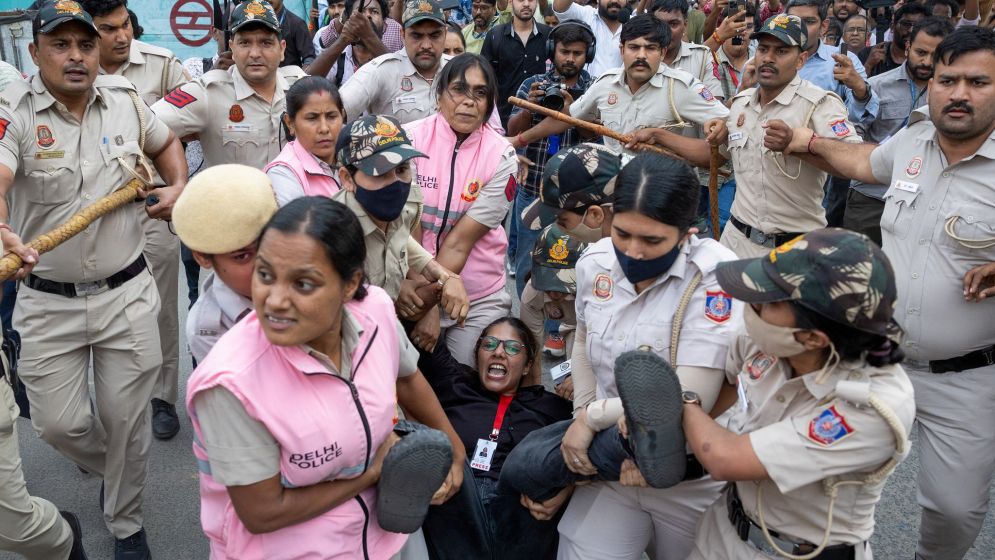
Security personnel and police detain a journalist during a protest by the Cockroach Janta Party (CJP) seeking the resignation of India's Chief Election Commissioner Gyanesh Kumar, near the protest site in New Delhi, India, 11 October 2026. Photo: REUTERS
Police used excessive and targeted force on journalists
covering youth-led protests in India, local press groups and international
media rights bodies said, and warned that press freedom in the country was
under threat.
Young Indians, mobilised by the "cockroach" youth
movement and supported by opposition parties, took to the streets of New Delhi
on the weekend demanding the resignation of India's Chief Election Commissioner
Gyanesh Kumar over a sharply contested revision of voter lists in the country.
They allege the names of more than 130 million voters were
deleted from the electoral roll to benefit Prime Minister Narendra Modi's
Bharatiya Janata Party in the elections, a charge the Election Commission
denies.
Nearly three dozen journalists from outlets including the
Indian Express, Scroll and Newslaundry, were detained for hours before being
released, according to Reuters interviews with some journalists.
Some were dragged and roughly handled by the police and
their phones were seized, according to a Reuters reporter at the scene,
journalists interviewed by Reuters, and footage from mainstream and digital
news outlets.
Some of those detained said they were clearly identifiable
as members of the press. The Reuters journalist was also briefly detained.
The Delhi police did not immediately reply to an e-mailed
request for comment on how many journalists were detained and why, and how they
were handled by officers.
Earlier, police said in a video posted on X that some
protesters had posed as journalists and had interfered with their work.
The government did not immediately respond to a request for
comment.
"The actions of the Indian authorities during the
recent student protests, led by the Cockroach Janta Party, demonstrate how
their tactics are designed to stifle media coverage and can be combined to
suppress journalism," said Ritika Jain, India representative of Reporters
Without Borders.
"Detention, surveillance, internet shutdowns, and the
removal of journalistic content form a chain of restrictions," she said,
urging authorities to remove restrictions on journalists.
Court ruled police should not impede reporters
The police action led lawyers to seek a ruling from India's
top court on Sunday to allow lawyers and journalists to perform their duties,
with the court ruling in favour.
However, some detentions came after the court order,
journalists said.
Press Club of India, the nation's largest journalist group,
called the police action "a blatant attack on the freedom of press."
In a joint statement with three other bodies, it said
journalists were held while they were filming the police detaining protesters
and their devices were seized.
The associations also sought a formal apology and
investigation into the actions of senior police officials.
"I was interviewing some people detained in a bus when
a police officer came at me and grabbed my mic...I was dragged, my phone was
snatched and I was forcefully detained along with my producer," Anmol
Pritam, a reporter at Indian digital news outlet Newslaundry, told Reuters. He
was detained for nearly three hours on 10 October.
Police did not respond to a request for comment on the case.
India ranks 157 out of 180 countries in the press freedom
index of Reporters Without Borders, having fallen from 133 a decade ago.
Critics attribute the drop to the Modi government's increased attempts to
restrain the press and shrink space for critical or dissenting voices in its
12-year rule. The Indian government has often denied the claim.
The Indian government did not immediately respond to a
request for comment e-mailed outside usual work hours.
The Indian constitution recognises journalists' rights under free speech provisions but also allows authorities to impose reasonable restrictions in the interest of public order.