



 For all latest news, follow the Daily Sun's Google News channel.


Saudi warning system stayed silent before deadly airport attacks
Reuters, Riyadh
Published: 13 Oct 2026, 10:38 PM
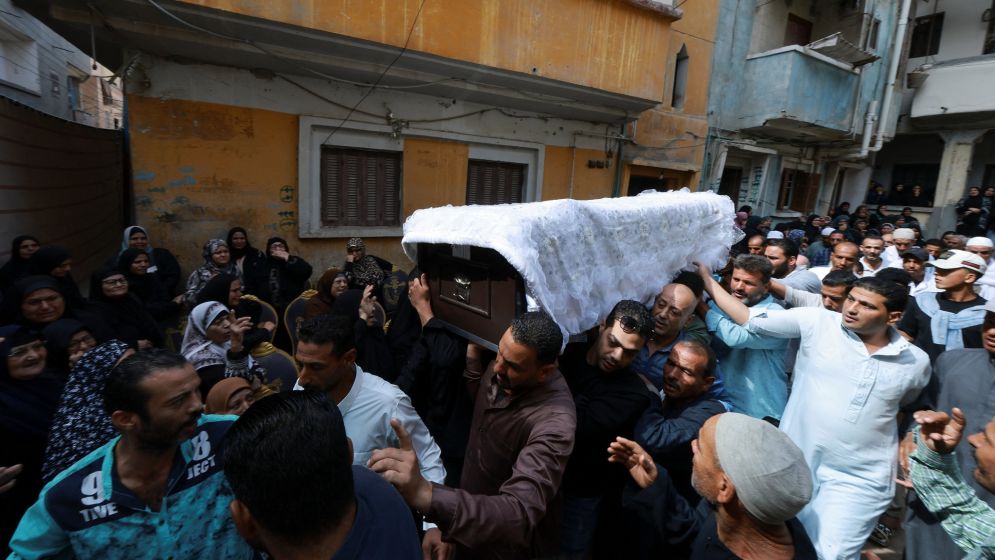
Relatives and mourners carry the coffin of Azza Ramzy, a 28-year-old Egyptian flight attendant killed in the attack at Riyadh airport, during her funeral in her home village of Al-Atf, El Mahmoudia district, Beheira Governorate, north of Cairo, Egypt, 13 October 2026. Photo: REUTERS
Saudi Arabia stopped issuing public warnings of imminent
military attacks days before a series of deadly strikes on Riyadh airport that
killed at least 18 people and wounded more than 300.
The government has not said why there were no alerts to the
public before the four Riyadh attacks in the past week.
The warnings had served to highlight the violence
undermining the kingdom's efforts to project an image of calm to its people and
the world during its war with Yemen's Iran-aligned Houthis.
Their absence during the airport strikes raised questions
about Saudi Arabia's vulnerability to attack and about its ability to protect
residents and visitors, four Western and Arab officials in the region and
political analysts told Reuters.
It also reflected efforts to maintain a sense of normalcy,
they said.
"They (the Saudi government) want to have it both ways: to launch a military operation and at the same time try to give confidence to the population and external stakeholders," said Sultan Alamer, a US-based Saudi academic and Senior Resident Fellow at the Middle East Policy Council think tank.
The Saudi civil defence - a national emergency management, rescue and firefighting agency which operates under the interior ministry and issues early warning alerts - and the Saudi government media office did not respond to emailed questions on why no alerts were issued.
Saudi Arabia's approach is also one that some regional
analysts said risked backfiring because the absence of warnings has heightened
uncertainty in the kingdom.
On Monday, Saudi Arabia's civil defence authority issued its
first alerts since September 29, warning of potential threats in Riyadh and
southern cities.
Reuters was unable to ascertain whether the decision to
issue alerts again was a response to the airport attacks, and the Saudi
government did not immediately respond to a request for comment on the matter.
System goes silent
All Gulf countries have been hit by Iranian drones and
missiles since the US-Iran war began in February, but their governments have
handled public warnings differently.
Qatar's interior ministry has issued mobile phone alerts
before nearly every attack, including most recent attacks in July, when
residents were warned to stay inside and away from windows.
Bahrain and Kuwait have repeatedly sounded sirens urging people to take shelter.
Saudi Arabia began issuing threat alerts to mobile phones and social media accounts via a national early warning system in May. But despite increasing Houthi attacks leading up to last week, the system went silent.
The last alert before last week's attacks was issued on
September 29, for the southern province of Najran, according to posts on the
civil defence X account.
The civil defences authority has continued to issue warnings
about staying out of harm's way during adverse weather, including rain and
flooding, and did so as recently as Monday.
It also warned residents not to share images, rumours or
information about interceptions and impact sites, including in a post on
Monday, under government regulations issued in March.
Reuters could not determine whether anyone had faced
prosecution for sharing such information, and the Saudi government media office
did not respond to a request for comment on the matter.
Before last week's airport attacks, officials from an allied
Western government asked Saudi authorities why the alerts had stopped, two
officials with direct knowledge of the matter said.
The response was that the alerts were too disruptive and
many citizens had complained they were being woken by them at night, the
officials said.
The Saudi government media office and Saudi officials did
not respond to requests for comment on the assertion.
Former US ambassador to Saudi Arabia Michael Ratney said
Riyadh was trying to balance public messaging on attacks with efforts to
prevent disruption in the kingdom but had ended up adding to a sense of unease
about the strikes.
"Their approach to public messaging seems like a
corollary to the quandary they are in: They need to respond to the Houthis but
don't want that to result in societal disruption and their public messaging is
a reflection of that," he said.
"But the lack of alerts of incoming Houthi attacks
creates the very nervousness they are trying to avoid."
New threat alert
Ali Shihabi, a Saudi analyst close to the government, said
that with or without early warnings, the kingdom would struggle to defend all
of its assets because of its size.
"In Saudi Arabia you have too much to protect. It's a
huge country with airports, pipelines and oil facilities. There is just not
enough coverage to defend everything at once, not enough Patriots (missile
defence systems), interceptors and missile batteries to do it all," he
said.
"Saudi Arabia has an unlimited need for air
defences," he added."
Despite the attacks, Saudi Arabia hosted an international
conference on Monday, though major oil bosses dropped out.
At the World Petroleum Council Energy Congress in Riyadh,
Saudi Prince Abdulaziz bin Salaman, a brother of the Saudi crown prince and the
kingdom's energy minister, struck a defiant tone while acknowledging risks and
Saudi Arabia's intent to keep its economic plans on track. He thanked all who
had travelled to Riyadh "because you know this country is safe" but
added: "Our gathering here does not mean the risk is gone.""We
will never forfeit any chance to maintain our commitment and our vision,"
he said.
Embassies issue their own internal alerts
Despite no public alerts being issued this month until
Monday, Riyadh has been attacked about a dozen times, two of the Western
officials said.
During that time, Western embassies in the kingdom have been
issuing their own internal missile and drone alerts to staff, according to
three people familiar with the matter and alerts seen by Reuters.
These internal alerts are compiled from a mixture of US and
other Western government intelligence and input from Saudi authorities, one of
those people said.
They include alerts sent to staff around the time of two
first airport strikes last week according to the people familiar with the
matter.
They said that even the embassies had received no internal
warning before Saturday's airport strike, without offering an explanation.
Reuters could not determine why no warning came before
Saturday's attack, the deadliest of last week's attacks.
On Sunday, Saudi state TV released footage of Saturday's
strike.
It showed several shots of travellers in the airport
terminal. Dozens lined up to board a flight. Men and women sat in chairs
waiting, their eyes trained on the screens of their mobile phones as they
scrolled.
Then, the bright orange flash of a missile explosion.