


 For all latest news, follow the Daily Sun's Google News channel.


Pakistan’s counterterrorism campaign is at an inflection point
If the new security framework fails to adopt a holistic approach to counterterrorism, it will once again end up treating the symptoms while ignoring the causes
The Diplomat
Published: 21 Oct 2026, 04:37 PM
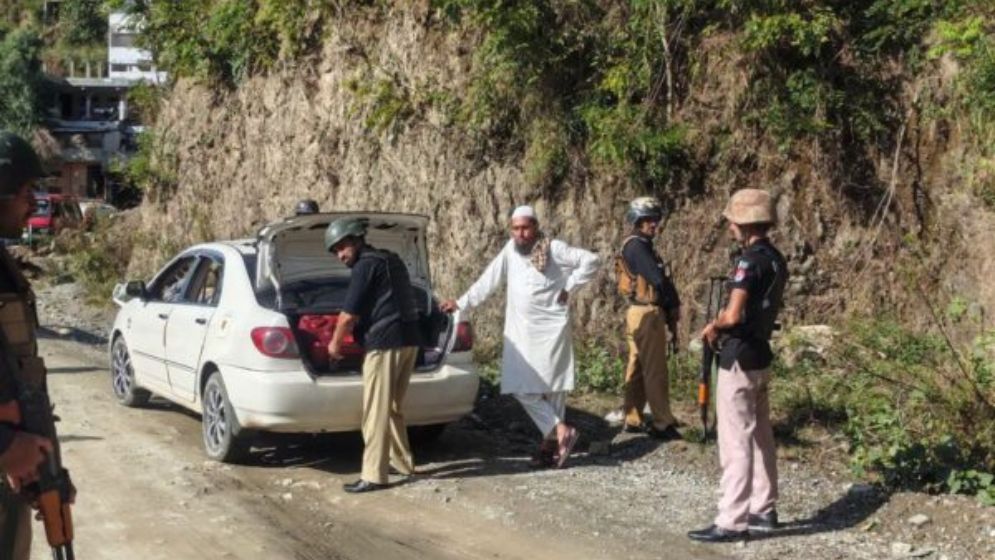
Pakistan security forces search a car in Pakistan's Khyber Pakhtunkhwa for weapons, 18 October 2026. Photo: The Diplomat
For the last several years, Khyber Pakhtunkhwa (KP) has been the epicenter of terrorism in Pakistan. However, 2026 marks an exception to this rule, as Balochistan has emerged as the most volatile region in terms of both the number of attacks and casualties.
As of 19 October according to the South Asia Terrorism
Portal’s open-source data, Balochistan had suffered 1,147 terrorist attacks,
and 2,394 deaths (424 civilians, 736 security personnel, and 1,233 insurgents
or terrorists, plus one death that was not categorised).
However, numbers provide only one aspect of a disturbing and
complex security situation.
With 12 of KP’s 36 districts witnessing a worsening
law-and-order situation and a receding writ of the state, Pakistan recently
imposed emergency and governor’s rule in the province.
Two militant networks, Tehreek-e-Taliban Pakistan (TTP) and
Ittehad-ul-Mujahideen Pakistan (IMP), have been carrying out large-scale
attacks from their hideouts in Afghanistan and reconstituted networks in the
Afghanistan-Pakistan border areas.
Since the Taliban’s return to power, the organisational
coherence, operational capacity, recruitment strategies, propaganda methods,
and fundraising techniques of these terrorist networks have significantly
evolved.
Against this backdrop, Pakistan’s counterterrorism approach
must be grounded in an accurate assessment of a complex and fluid threat
landscape.
Taking an over-simplistic view of a complicated threat
picture would result in temporary respite instead of permanent peace.
Therefore, taking a holistic and nuanced view of Khyber
Pakhtunkhwa’s security situation is the first step in restoring peace in the
province.
Terrorism in KP predates the Pakistan Tehreek-e-Insaf’s
(PTI) three successive governments in the province. In fact, its contemporary
roots can be traced to the May 1994 Malakand uprising of Sufi Muhammad’s
Tehreek-e-Nifaz-e-Shariat-e-Muhammadi (TNSM).
Since then, terrorism has persisted in KP in one form or another. Therefore, terrorism in the province is despite, and not because of, the PTI’s provincial regime. The PTI’s lack of cooperation is just one of the several factors that have contributed to a worsening law-and-order situation in the restive province.
Nevertheless, it is quite unfortunate that the PTI politicised internal security.
Pakistan’s flawed pro-Taliban Afghan policy, kinetic-heavy
counterterrorism approach, governance deficit, underdeveloped non-kinetic
counterterrorism framework (or a Preventing and Countering Violent Extremism
policy), and absence of structural reforms have cumulatively contributed to the
current security situation in KP.
If the new security framework fails to adopt a holistic
approach to counterterrorism, it will once again end up treating the symptoms
while ignoring the root causes.
Since the military is Pakistan’s most developed and capable
security institution, the country has heavily leaned on it to suppress
terrorism. By and large, military operations have proved successful in
dismantling terrorist networks, their command-and-control nodes, organisational
infrastructure, and logistical pipelines.
However, the absence of political processes required to
translate those tactical advantages into permanent strategic gains reversed
improvements in security.
Going forward, transparent and timely strategic
communication is crucial in fighting and discrediting terrorist networks.
Pakistani security institutions must ensure transparent and
timely communication grounded in the rule-of-law approach to reclaim the
narrative domain from violent nonstate actors.
They must provide a realistic assessment to the public that
the military has no magic wand to bring an overnight improvement in the
security situation.
It will be a long struggle before peace can be restored. The
first step would be to reduce the intensity of terrorist attacks and their
impact. Then, large-scale kinetic operations will be required to blunt the
sharp edge of terrorism.
Here, strategic communication is important. It will involve
a two-pronged effort. First, the government must comprehensively address public
concerns about why previous operations, despite their mixed results, were
necessary. Faulting them alone for terrorism’s recurrence is unfair. The blame
equally goes to the absence of political processes and good governance. There
is a need for constitutional and administrative reforms too.
Second, the government must unambiguously convey to the
masses how and why the new counterterrorism operations will be different from
their previous iterations.
Persistent and timely communication to the public will
bridge the existing perception gaps about previous counterterrorism policies
and their outcomes. Especially in the age of social media, terrorists are
exploiting communication gaps and information blackouts.
Malevolent actors jump into these situations to misguide
public perception through misinformation and disinformation campaigns.
Therefore, ensuring continuous and consistent communication about the progress
of counter-terrorism operations and challenges confronting them will be
critical.
Likewise, unlike in the past, the security institutions will
do well to avoid premature victory declarations. Such pronouncements, especially without
consolidating security gains through kinetic operations into permanent
strategic advantages, can result in complacency and a false sense of security.
This time around, the absence of violence must not be mistaken for peace.
This happened during the 2015-2020 period when a decline in
terrorist attacks and the displacement of terrorist networks was confused with
their elimination.
The premature victory trap is tempting but dangerous, as it
erodes public trust, which is central to the success of counterterrorism
initiatives.
Similarly, a clear distinction between eliminating terrorists
and terrorism is important. Terrorists, despite their elimination, keep
returning to the battlefield as long as the roots of terrorism are not
adequately tackled. Terrorism keeps the recruitment pipeline alive by
exploiting ideological, political, and socioeconomic grievances.
Terrorism is effectively tackled when terrorists are
ideologically and discursively discredited to a point where the masses reject
their appeal despite having reservations about the state. For that,
strengthening state-society relations, or renewing the social contract, is
important.
The glue that keeps states and societies together is
governance. Making state policies and administrative apparatus receptive to
people’s needs and demands will drain the swamp where terrorists germinate.
Finally, terrorism in Pakistan has its internal and external
dimensions. Internal consolidation against terrorist networks constitutes a
necessary but not sufficient condition to overcome the challenge of terrorism.
Pakistan will have to evolve a two-pronged policy, involving proactive
diplomacy and coercion.
Diplomatically, Pakistan must highlight the Taliban’s
support for the TTP, IMP, and Baloch separatist groups. At the same time,
Pakistan should impose punitive costs on Kabul for allowing Afghanistan’s soil
to be used for cross-border terrorism against it.
Pakistani air strikes in Afghanistan should aim to destroy
terrorist hideouts as well as the Taliban’s military capabilities to a point
where they revisit their strategic calculus of supporting the TTP and IMP.
The declaration of emergency in KP marks an inflection point
in the evolution of Pakistan’s counterterrorism policy. A prudent, holistic,
transparent, and proactive approach with a long-term vision will deliver peace
dividends.
A reactive, kinetic-heavy approach, lacking concomitant
non-kinetic interventions and a transparent communication strategy, will
deliver short-term respite at the cost of long-term peace.