


 For all latest news, follow the Daily Sun's Google News channel.


The DNCC Dedicated COVID-19 Hospital in Mohakhali has fully transitioned into a specialised treatment facility for measles to cope with a sharp rise in infections across the country.
Hospital authorities report treating 400-500 patients daily, with provisions in place to scale up bed capacity should the crisis deepen.
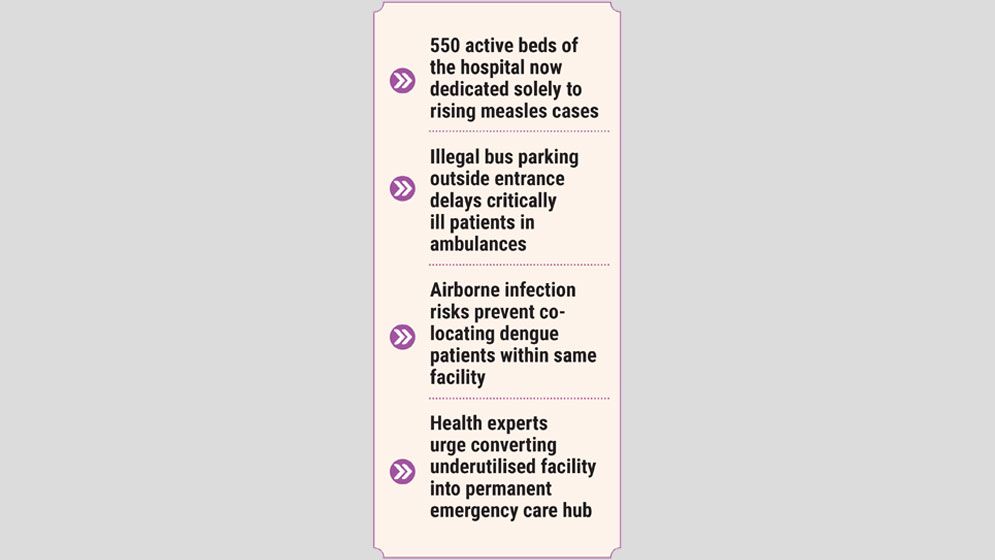
Speaking to the Daily Sun, the hospital’s director, Col Dr Latifa Rahman, said the facility currently operates around 550 active beds, including 500 general and 50 ICU/HDU units.
“We are now fully dedicated to measles care. Alongside inpatient treatment, we are administering vaccines and providing essential clinical support,” Dr Latifa said, adding that while the facility operates 550 active beds, infrastructure exists to expand capacity up to 1,050 beds if required.
Official statistics provided by the hospital’s spokesperson, Dr Asif Haider, show that 355 measles patients were admitted as of Monday.
Over the preceding 24-hour cycle, 88 new patients were admitted while 103 were discharged.
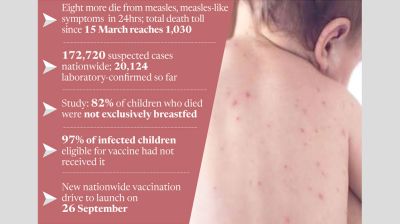
The facility has treated 16,229 measles cases and recorded 146 fatalities since the onset of the surge.
The figures reflect a slight dip from the previous day, when 372 patients were undergoing care, with 112 admissions and 99 discharges.
To maintain operations, a workforce of 126 doctors and 122 nurses, alongside armed forces personnel, is working in shifts to manage the patient load.
Dengue co-location ruled out
Addressing recent warnings from State Minister for Health and Family Welfare Dr MA Muhit regarding a projected peak in dengue cases in late September and early October, Dr Latifa clarified that the hospital cannot treat dengue and measles patients within the same physical framework.
“Measles is highly contagious and airborne. Co-locating dengue patients under the present setup is clinically unsafe,” she explained. “If we are tasked with managing dengue cases, it will require a completely separate wing and dedicated facilities.”
She noted that the structure, built by the Dhaka North City Corporation (DNCC), was originally designed for commercial use rather than medical services. Expanding operations to handle dual outbreaks would necessitate rapid structural modifications.
Illegal parking impedes emergency access
The hospital’s operational response is currently being hampered by persistent traffic congestion outside its main entrance. Long-distance buses operating out of the nearby Mohakhali Inter-District Bus
Terminal routinely park along the hospital gate, obstructing access for incoming emergency vehicles.
“Critically ill patients are being brought in from across the country, but ambulances frequently get trapped in traffic created by parked buses,” Dr Latifa said, adding that altercations between bus workers and hospital security staff have become common.
She cited a recent incident where a critically ill child transferred from another district died inside an ambulance after the vehicle became stuck in the gridlock just yards from the entrance. She urged civil authorities and traffic police to enforce a clear zone around the entrance immediately.
Wards operating smoothly
Despite external logjams, operations inside the wards remain structured. Families of admitted patients expressed satisfaction with the level of care, noting that medicine, supplemental oxygen, nebulisation, and isolation protocols are being maintained systematically.
In the paediatric ward, Mohammad Sabbir Ahmed, a 22-month-old child transferred from Faridpur, showed marked recovery after four days of treatment.
His father noted that the facility provided consistent oxygen support and routine monitoring in a clean environment, comparing the setup favourably with district-level facilities.
Another patient, four-and-a-half-month-old Tanvir from Mirpur, was admitted with measles complicated by respiratory distress.
His father, a local bus driver, shared that three other family members had recently been treated for the infection.
Early admission and immediate oxygen administration helped stabilise the infant without requiring ICU intervention.
Long-term utility of the complex
Commissioned in April 2021 during the peak of the pandemic, the six-storey, 180,560-square-foot facility was built as one of the country’s largest dedicated pandemic units, complete with central oxygen systems and diagnostic facilities for over 50 test types.
Following the decline in Covid-19 cases, the complex remained underutilised.
A 2022 proposal to convert the facility into a general hospital was never fully implemented.
Health experts argue that the current outbreak underscores the need to formally integrate the building into Bangladesh’s emergency response network. Public health specialist Dr Mohammad Mushtuq Husain suggested that the facility’s extensive ICU and HDU infrastructure should be permanently designated as an infectious disease and critical care backup unit to relieve pressure on other public tertiary hospitals during seasonal spikes.
Read More