



 For all latest news, follow the Daily Sun's Google News channel.


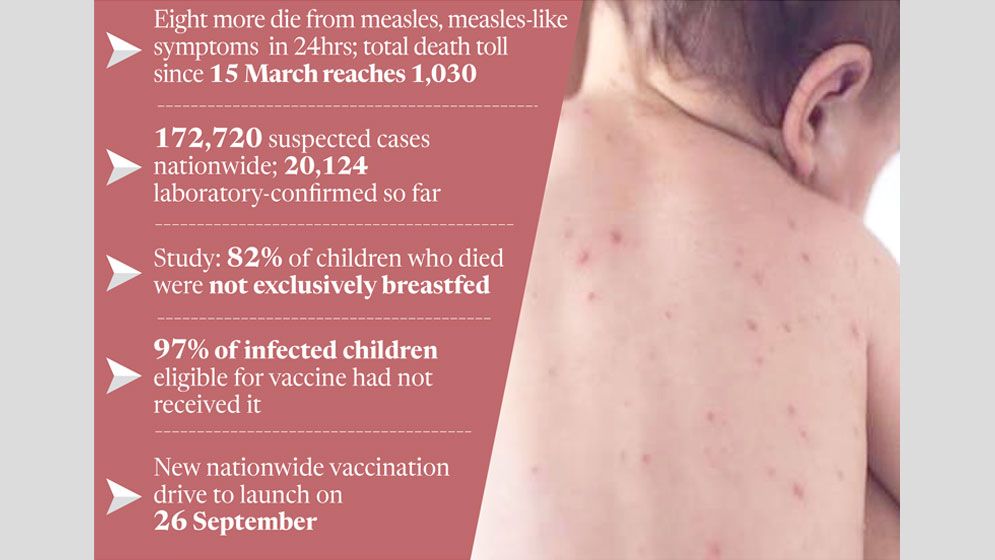
Malnutrition and weakened immunity are among the leading factors behind the high number of child deaths in Bangladesh’s ongoing measles outbreak, health officials said, as the death toll rose to 1,030 with eight more children dying in the 24 hours to 8am Monday.
“The exact reason behind so many deaths of children from measles is yet to be examined. However, so far we can say that malnutrition is one of the major risk factors,” Prof Dr Md Halimur Rashid, director (disease control) at the Directorate General of Health Services (DGHS), told the Daily Sun.
According to the World Health Organisation, measles is a highly contagious viral disease spread through coughing, sneezing and close contact, and can lead to severe complications and death.
The WHO said children are most commonly affected, with symptoms including high fever, cough, runny nose and a body rash.
Vaccination remains the most effective means of prevention, it added, with unvaccinated children and pregnant women at highest risk of severe complications.
The DGHS said the outbreak has killed 1,030 people and infected more than 172,720 across the country since it began six months ago.
The 24-hour period to Monday morning recorded eight new suspected deaths and 1,177 new suspected cases.
Of the 172,720 suspected cases nationwide, 20,124 have been laboratory-confirmed. Confirmed deaths stand at 100, with suspected deaths at 930.
Since 15 March, 152,117 suspected patients have been hospitalised, of whom 146,400 have recovered.
Health officials attributed the continuing surge to a persistent vaccination gap, waning immunity following incomplete dosing, malnutrition among vaccinated children, and a failure to reach the herd immunity threshold, despite ongoing vaccination efforts.
Ariful Bashar, consultant at the Infectious Diseases Hospital in Dhaka, told the Daily Sun that measles is typically a seasonal disease in Bangladesh, usually rising in December and peaking between February and April – but this year’s outbreak has reached unusually severe levels.
“The main reason behind this devastating outbreak is the cumulative vaccination gap since 2019, which prevented herd immunity from being established. Herd immunity cannot be achieved through a one-year emergency vaccination campaign alone,” he said.
Bashar said malnutrition and weak immunity were the principal drivers of the high fatality rate among children, compounded by late hospital admission and limited intensive care capacity.
He also called for further study into whether maternal immunity had been disrupted, noting that early measles incidence among very young children pointed to possible gaps, which could be addressed by vaccinating adolescent girls under the MMR programme.
“Regular vaccination must continue. At the same time, MMR vaccination for girls around 15 years of age must be ensured so that they develop strong immunity before becoming mothers,” he said.
A joint study by Bangladesh Shishu Hospital and Institute and icddr,b, conducted between March and July 2026 among children aged zero to 14, found that nearly 82% of children who died from measles this year had not been exclusively breastfed during their first six months of life.
The study also found that 97% of infected children who had reached vaccination-eligible age had not received the measles vaccine.
Researchers said the spread of the highly contagious B3 strain coincided with gaps in both vaccination coverage and maternal antibody transfer through breastfeeding.
The study further found that 65% of infected children suffered from malnutrition – 12% severely and 53% moderately – while 38% of all infected children had not been exclusively breastfed in their first six months, a figure that rose to 82% among those who died.
Professor Dr Mirza Md Ziaul Islam, director of Bangladesh Shishu Hospital & Institute, said malnutrition, inadequate breastfeeding, delayed vaccination and poor maternal nutrition were the principal factors behind both infection and fatality rates.
“After birth, infants should be fed colostrum and exclusively breastfed for the first six months; they should also be accustomed to a balanced diet to build strong immunity,” he said, also advising vaccination and avoidance of crowded gatherings during the outbreak.
The government has run a phased emergency vaccination campaign since April: the first phase covered 30 upazilas across 18 districts from 5 April; the second began on 12 April in Dhaka South, Dhaka North, Barishal and Mymensingh city corporations; and a nationwide drive commenced on 20 April.
According to DGHS figures, against a target of vaccinating 18,015,064 children, 19,779,130 – or 109.8% of the target – have been vaccinated as of 14 September.
Halimur Rashid said the government would launch another nationwide vaccination campaign on 26 September in response to the continuing outbreak.
Read More