


 For all latest news, follow the Daily Sun's Google News channel.


Bumper harvest fail to reduce concern over price for Rajbari jute farmers
Some farmers are still holding unsold jute from last year's harvest
Daily Sun Report, Kushtia
Published: 20 Jul 2026, 03:32 PM
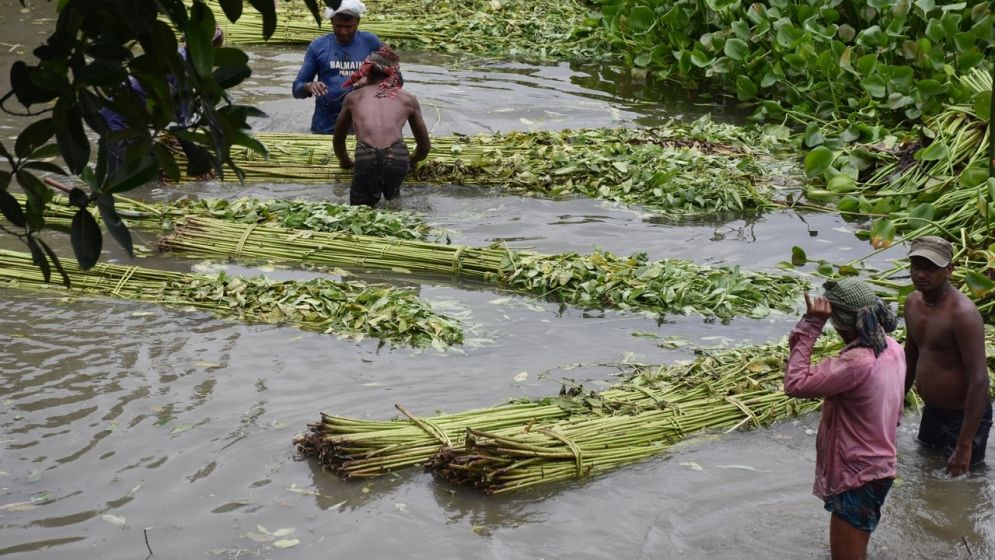
Farmers harvesting jute in Rajbari. Photo: Daily Sun
Rajbari has recorded a bumper jute harvest this season, with impressive yields reported across all five upazilas of the district.
Harvesting is now in full swing, while farmers
continue retting the stalks and extracting the golden fibre. Favourable weather,
timely rainfall, and improved cultivation practices have played a key role in
boosting yields.
Despite the bumper harvest, farmers remain deeply
concerned about market prices. They fear that unless they receive fair prices
for their produce, the increased output will fail to generate profits and may
not even cover their production costs.
According to the Rajbari Department of Agricultural
Extension (DAE), jute has been cultivated on 47,780 hectares of land in the
district during the 2026–27 fiscal year. The cultivated area includes 12,300
hectares in Pangsha, 12,150 hectares in Baliakandi, 9,850 hectares in
Kalukhali, 9,260 hectares in Rajbari Sadar, and 4,220 hectares in Goalanda,
representing a slight increase from the previous year.
While production has increased, so has market
supply. Farmers fear that unless export demand and industrial consumption
expand at a similar pace, the surplus supply could push prices downward.
Small and marginal farmers would be the worst
affected, as most lack the financial capacity or storage facilities to hold
their produce until prices improve. Consequently, many are forced to sell their
jute immediately after harvest at relatively low prices.
Local agricultural economists described jute as a
vital engine of the district's rural economy. The crop sustains thousands of
livelihoods, from cultivation and harvesting to transportation and
trading. A decline in jute prices would
therefore affect not only growers but also the wider rural economy.
Conversely, fair prices would increase farmers'
purchasing power, stimulating local markets, small businesses, and household
consumption.
Several big jute mills have also running with
several thousands of labourers in the district.
A visit to several fields in Baliakandi and
Kalukhali revealed farmers actively engaged in harvesting, retting, and fibre
extraction. Although satisfied with the yield, almost everyone voiced the same
concern: What price will the market offer?
Asaduzzaman Arzoo, a farmer from Habaspur in Pangsha
Upazila, said that they have already suffered losses from onion cultivation.
Now jute is their only hope.
“If we fail to receive a fair price for this crop as
well, continuing farming will become extremely difficult," the farmers
said.
Farmers say the cost of cultivating jute per bigha
has risen substantially compared with previous years. Higher expenditures on
fertilisers, seeds, pesticides, irrigation, retting, and labour have
significantly increased production costs, leaving only a narrow profit margin
unless market prices improve.
Golam Rasul, training officer of the Rajbari
Department of Agricultural Extension, said that favourable jute prices last
year encouraged farmers to expand cultivation this season. Coupled with
favourable weather, this has resulted in an excellent harvest.
However, he noted that future prices will largely
depend on domestic demand and export performance.
He added that domestic consumption of raw jute
remains limited. Without stronger export growth, the increased supply could
place downward pressure on prices.
Moreover, some farmers are still holding unsold jute
from last year's harvest, and once these stocks enter the market alongside this
season's production, prices may face additional pressure.
Agricultural officials cautioned that without guaranteed
fair prices, many farmers may be forced to reduce or discontinue jute
cultivation next season.
They warned that such a development could have
lasting repercussions, lowering production and affecting the long-term
sustainability of Rajbari's agriculture-driven economy.
Mazedul Islam, associate professor at the Department
of Marketing in Kushtia Islamic University, called for improved market
oversight, expanded export opportunities, more effective government
procurement, and greater investment in storage facilities to safeguard farmers'
incomes.