


 For all latest news, follow the Daily Sun's Google News channel.


Bangladesh’s leather industry, long dogged by pollution controversies and poor waste management, may be standing on an economic goldmine it has yet to fully appreciate.
Industry experts now argue that the country could earn an additional $10 billion annually by developing its alternative rawhide sector – transforming what is currently treated as industrial refuse into a suite of commercially valuable products.
The scale of the opportunity is difficult to overstate.
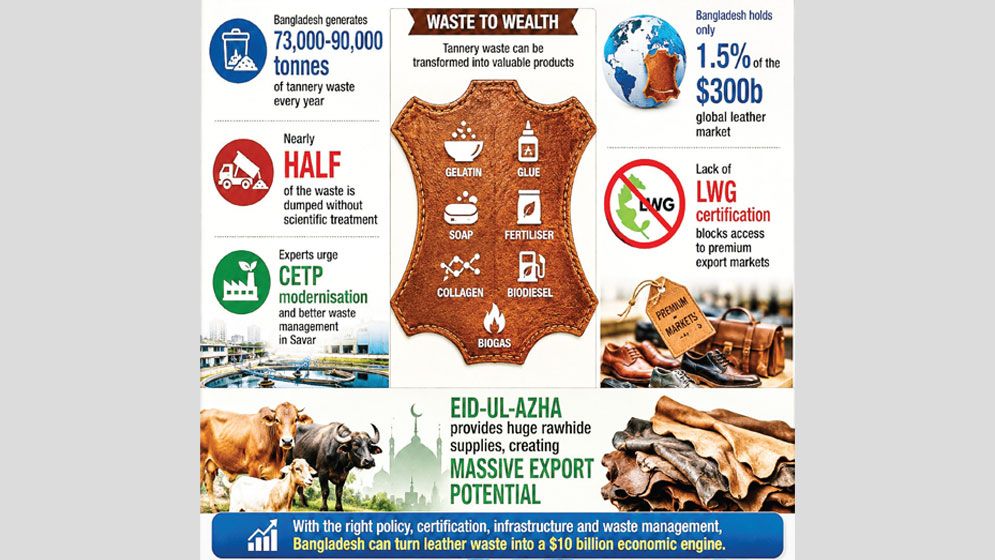
According to Business Initiative Leading Development (BUILD), Bangladesh generates between 73,000 and 90,000 tonnes of tannery solid waste (TSW) every year.
Roughly half of this is disposed of without any scientific treatment, with fleshings and toggle trimmings accounting for the largest share of what is simply dumped.
The environmental damage is considerable. Yet buried within that waste lies the raw material for gelatin, glue, soap, leather board, fertiliser, collagen, biodiesel, pigments, and biogas – products that Bangladesh currently imports at considerable cost despite possessing the primary inputs domestically.
Dr Mohammed Mizanur Rahman, former director of the Institute of Leather Engineering and Technology (ILET) and a professor at Dhaka University's Department of Applied Chemistry and Chemical Engineering, put the broader picture plainly.
"Bangladesh can earn a total of $20 billion annually from leather, leather goods, and the alternative rawhide sector combined. Of this, the alternative industry alone could export $10 billion. There is huge scope for export earnings," he told the Daily Sun.
He noted that rawhides can be used in the production of cosmetics, perfume, collagen, animal feed, and various industrial materials – sectors in which other countries have built thriving export industries.
"Bangladesh's leather quality is very excellent in the world. But due to lack of proper policy and compliance issues, Bangladesh is losing a lot of opportunity," he said.
The global leather and leather goods market is valued at approximately $300 billion. Bangladesh currently holds around a 1.5% share – a modest foothold that experts say could grow substantially with the right policy architecture in place.
A critical bottleneck in unlocking that potential is certification. Persistent difficulties in obtaining Leather Working Group (LWG) accreditation – which requires robust management of both liquid and solid waste – continue to shut Bangladeshi exporters out of premium international markets.
Dr Mizanur believes the returns from wider certification would be immediate and tangible.
"Currently, several companies have received LWG certificates. If 100 companies receive them, our leather exports will increase significantly, and our local rawhide price will rise to Tk4,000–5,000 from the current less than Tk1,000. It will strengthen our local industries as well," he stressed, calling on the government to train slaughtermen and modernise the Central Effluent Treatment Plant (CETP) at the BSCIC Tannery Industrial Estate in Savar.
The relocation of tanneries from Hazaribagh to Savar, intended to consolidate the industry and improve environmental compliance, has not delivered the anticipated results.
Despite the Savar CETP being the largest in South Asia, estate management remains deeply problematic and environmental non-compliance continues to prevent exporters from commanding premium global prices.
Md Shaheen Ahamed, chairman of the Bangladesh Tanners Association (BTA), acknowledged the structural difficulties whilst flagging fresh administrative uncertainty.
The management of the Tannery Industrial Estate Dhaka (TIED) is being transferred from the Bangladesh Small and Cottage Industries Corporation (BSCIC) to the Bangladesh Economic Zones Authority (BEZA) – a shift the BTA views with concern.
"BSCIC traditionally looks after the interests of SMEs," Shaheen Ahamed noted, warning that the new arrangement may require fresh lease deeds and compound existing burdens on estate entrepreneurs.
He also referenced an EU-supported initiative that has expressed willingness to establish an advanced CETP within the estate, and reiterated the urgency of allocating land for small TSW-based industries under the long-stalled second phase of the Development Project Proforma (DPP).
He added that TSW materials would benefit from management by a centralised entity to bring structural discipline to the supply chain.
Ferdaus Ara Begum, chief executive of BUILD, framed the challenge in terms of both obligation and opportunity.
"Improved compliance with environmental standards, proper treatment and utilisation of waste, and stronger collaboration among government agencies, industry stakeholders, and development partners are critical to reducing environmental risks while unlocking new economic opportunities," she said.
AM Sajjad Hossain Khan, senior project manager at The Asia Foundation, underscored the need to bring informal actors into the fold. He highlighted key waste streams – fleshings, raw trimmings, split leather waste, and shaving dust – all of which carry strong potential for value addition.
Emerging byproduct industries in Bangladesh are already producing gloves, gelatin, glue, leather board, shoe soles, soap, and small leather goods, though these activities remain largely informal and fragmented, constrained by weak supply chains, limited infrastructure, and scant policy recognition.
On the government side, Md Khairuzzaman, deputy secretary at the Ministry of Industries, confirmed that plot allocation for TSW entrepreneurs in the Savar estate is under way, supported by an ongoing feasibility study, and that preparatory work for the CETP's second phase is progressing.
Dr Md Razzaqul Islam, deputy secretary at the Ministry of Commerce, noted that a comprehensive gap analysis had been conducted through the Business Promotion Council to map sectoral constraints and identify development opportunities, describing the leather sector as one with "100% potential for value addition."
With 1.23 crore sacrificial animals expected to be slaughtered this Eid-ul-Azha – a replenishment of raw material that most competing nations simply cannot match – the annual window is clear.
What remains less clear is whether the policy will catch up with the potential before that advantage is quietly squandered, analysts conclude.
(This is the last instalment of a two-part series on Bangladesh’s leather sector)