



 For all latest news, follow the Daily Sun's Google News channel.


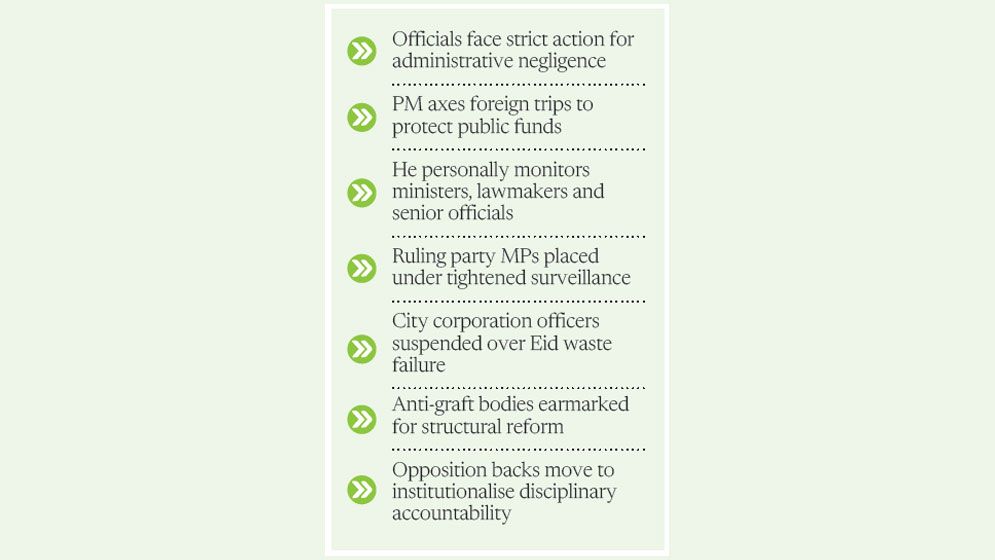
Prime Minister Tarique Rahman has moved to stamp out administrative misconduct and curtail unnecessary overseas travel by government officials, warning that no individual or institution will escape accountability under his watch.
Tarique, also the chairman of the ruling BNP, has personally taken charge of monitoring the conduct of cabinet members and lawmakers, with special surveillance reportedly placed on between 70 and 80 of his own party’s parliamentarians.
The message from Dhaka’s power centre is unambiguous: the era of institutional impunity is over.
“The prime minister is working tirelessly round the clock, stressing the need for boosting his government’s commitment to transparency and good governance,” said Mahdi Amin, adviser to the prime minister and spokesperson for the Prime Minister’s Office (PMO), at a press conference on Monday.
The administration has declared a zero-tolerance policy against corruption, and Tarique has backed the declaration with action.
On Eid day, he made unannounced visits to several parts of the capital and found that officials from both Dhaka North and South City Corporations had failed to clear waste from sacrificial animals within the required 12-hour window.
He responded by ordering the temporary suspension of two zonal executive officers on the spot – a signal, observers say, that the oversight is neither performative nor selective.
The same instinct drove his rejection of a proposal from Chattogram City Corporation (CCC) officials seeking approval to travel to Florida to study mosquito eradication techniques.
The prime minister was characteristically blunt in his refusal.
“There is no need to go to Florida to learn or observe mosquito control activities,” he said.
“Just by staying near any shallow body of stagnant water in the country after dusk for two or three hours, it is possible to find out many innovative methods of mosquito control.”
Beyond individual interventions, the government is pursuing structural reforms.
Plans are underway to overhaul key anti-corruption bodies, including the Anti-Corruption Commission (ACC), with a stated aim of creating a political environment free from abuse of power, extortion and patronage.
Reaction from outside government has been broadly positive.
Political analyst and economist Professor Mahbub Ullah said Rahman had wasted little time in trying to restore discipline to public administration, pointing to the city corporation suspensions as evidence of genuine rather than token oversight.
“Three months is a very small time to assess a government’s performance. Despite this, Tarique Rahman, from the very beginning of his journey, has started implementing his party’s election manifesto, which is really a commendable step,” he said.
On the rejected Florida trip, Mahbub Ullah suggested the prime minister was equally concerned with public finances. “I think the prime minister may have wanted to rein in the trend to save public money,” he said.
Iftekharuzzaman, executive director of Transparency International Bangladesh (TIB), welcomed the moves but struck a cautionary note.
“These are commendable instances of leading by example. The point to remember, however, is that the government is not run by the prime minister alone – others in positions of power must follow and sustain similar practices,” he told the Daily Sun.
He warned that the administration needed to identify and address pockets of resistance within the system, particularly from sections of the bureaucracy and, crucially, from within the ruling party’s own ranks. Without that reckoning, he said, the risk was that good intentions would be quietly absorbed by the old order.
“If they cannot be persuaded to take the proper lessons from such good practices – rather than indulge in the prevailing ‘winner takes all’ syndrome – things may soon revert to business as usual. Abuse of entrusted power must be controlled before it is normalised again beyond control,” said Iftekharuzzaman, a prominent economist and anti-corruption campaigner.
The main opposition Bangladesh Jamaat-e-Islami also offered measured support.
Dr Syed Abdullah Mohammad Taher, the party’s nayeb-e-ameer, welcomed the suspensions and argued the approach should be embedded into standard practice rather than applied sporadically.
“Not only the prime minister, but we all must ensure such visits to address anomalies and irregularities in every sector,” said Taher, who represents the Cumilla-11 constituency in parliament.