



 For all latest news, follow the Daily Sun's Google News channel.


Is real measles toll being hidden in Chattogram?
2,305 cases, 12 deaths recorded in 4 months

In the last week of February, a mother rushed her five-year-old child to an upazila health complex in Chattogram. After several days of fever, red eyes, and a rash spreading across the body, the family initially assumed it was a common viral infection. Doctors, however, diagnosed the child with measles.
What began as a handful of isolated cases in February has, within just four months, developed into a significant public health concern in the port city, mirroring outbreaks elsewhere in the country. Yet health professionals and affected families suggest that official figures may not fully reflect the scale of the outbreak.
According to the latest data from the Chattogram Civil Surgeon’s Office, as of Tuesday (2 June), a total of 2,305 suspected measles cases have been reported across the district, with 2,214 cases in Chattogram city alone. Currently, 277 patients are undergoing treatment at various hospitals in the city and district.
Officially, nine suspected measles patients and three laboratory-confirmed patients have died. However, doctors, health workers, and families claim the actual toll may be higher. Public health experts warn that the reported 12 deaths could only represent a fraction of the real impact.
The grief behind official statistics
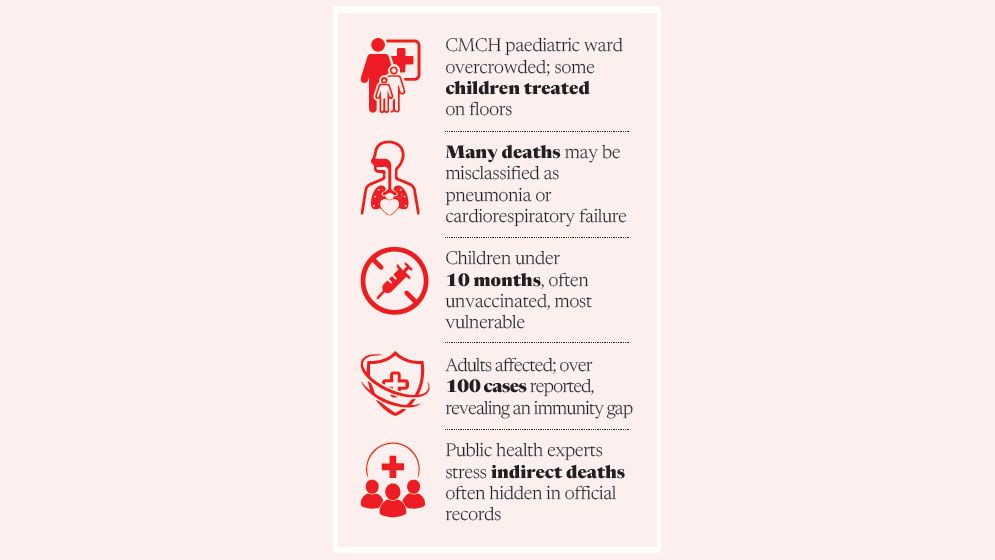
A visit to the paediatric ward of Chattogram Medical College Hospital (CMCH) reveals why many consider the official figures incomplete. The ward is overcrowded, with patient numbers far exceeding capacity. In several cases, two children share a single bed, while others are treated on the floor.
Among them is Rabeya Begum from Satkania upazila, who has been staying at the hospital with her two-and-a-half-year-old son.
“People in our village thought it was just a seasonal fever at first,” she said. “When my son started having difficulty breathing, we brought him here. I haven’t slept properly for a week. I just want my son to survive.”
Doctors confirmed that the child developed pneumonia following measles infection. Another mother, Nasrin Sultana, pointed out that many measles-related deaths may never appear in official records.
“When a child dies here, the death certificate often lists the immediate cause as severe pneumonia or cardiorespiratory failure,” she said. “But the pneumonia may have developed because of measles. That link often disappears from the records, which means the true measles death toll remains hidden.”
A senior health official in Chattogram, speaking on condition of anonymity, acknowledged that official data may not capture the full extent of the outbreak.
“Many patients never get tested, while some deaths occur outside hospitals,” the official told the Daily Sun. “There is a strong possibility that the actual number is higher than what appears in government records.”
Public health expert Prof Dr Mohammad Jalal Uddin warned that the official figures may not reflect the full impact of the outbreak. “Indirect deaths from measles are often more common than direct deaths. If a child dies from measles-related pneumonia, the death may ultimately be recorded as a pneumonia death. As a result, the real mortality burden of measles often remains concealed.”
Complications persist after recovery
Doctors report a growing number of children who fall seriously ill shortly after being discharged. In the past month, at least five children required intensive care unit (ICU) readmission, and another four were admitted to high dependency units (HDUs) due to complications arising days after returning home.
According to Civil Surgeon’s Office data, an average of 10–15 children are being transferred daily to paediatric ICUs and HDUs. The rising patient load is putting considerable pressure on doctors and nurses.
Physicians note that many children leave hospital before full recovery, and inadequate post-discharge care contributes to complications such as pneumonia, diarrhoea, and malnutrition.
CMCH Paediatrics Department head Prof Dr Mohammad Musa said it takes one to one-and-a-half months for a child’s immune system to recover after measles.
“Any illness during this period can have serious consequences,” he said. “This is particularly common among children under 10 months of age, many of whom have not received even a single dose of the measles vaccine.”
Adults are also at risk
Although measles is generally considered a childhood disease, the current outbreak is increasingly affecting adolescents and adults in Chattogram. Over 100 adult patients with measles or measles-like symptoms have been identified, with at least 50 requiring hospitalisation.
Sources at Chattogram General Hospital report that 40 adult patients received treatment there, with three, including a 55-year-old woman, remaining admitted.
Public health experts describe this as evidence of an “immunity gap” — a population segment that either missed vaccination during childhood or failed to complete the recommended two-dose schedule.
Dr HM Hamidullah Mehedi, assistant professor at Chattogram General Hospital, said, “Many adults never completed the full vaccination schedule. Others still believe measles is only a childhood disease and delay seeking treatment.”
Response measures
Chattogram district Civil Surgeon Dr Jahangir Alam said authorities have intensified Outbreak Response Immunisation (ORI) campaigns in high-risk areas. Treatment facilities for measles patients have been expanded, and disease surveillance has been strengthened through field-level health workers to ensure faster detection and more accurate reporting of cases.
Asked about the controversy over official figures, Dr Alam added, “It is difficult to determine the actual number of patients, as many people are not seeking diagnosis for the disease like they did during COVID-19.”