



 For all latest news, follow the Daily Sun's Google News channel.


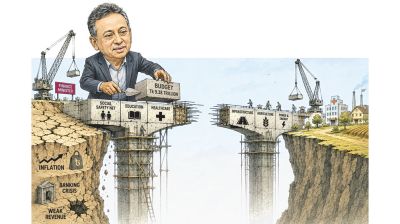
Investor sentiment in the capital market has turned positive ahead of the national budget for FY2026-27, set to be presented in Parliament today, amid expectations of pro-market fiscal measures and continued gains in key market indices.
Market participants say anticipation of budgetary support, coupled with a recent rebound in trading activity and index performance, has helped restore confidence after a prolonged period of stagnation and liquidity constraints.
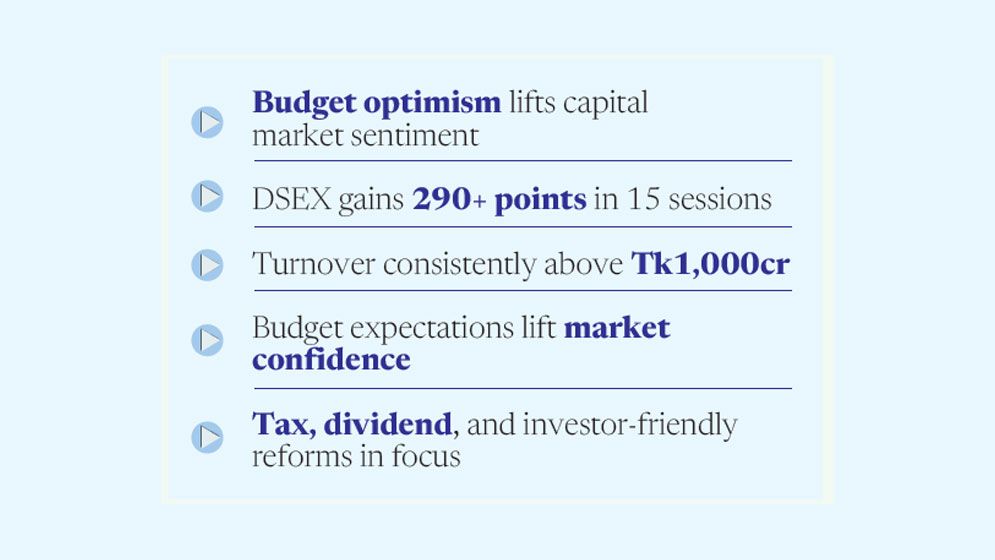
Over the past few weeks, the benchmark DSEX index of the Dhaka Stock Exchange (DSE) has maintained a steady upward trend. The index climbed from 5,226 points on 17 May to 5,516 points on 10 June, gaining more than 290 points in just 15 trading sessions.
Trading activity has also strengthened significantly. Daily turnover, which remained largely between Tk600 crore and Tk800 crore in mid-May, has consistently exceeded Tk1,000 crore since early June.
Turnover reached Tk1,351 crore on 4 June, rose to Tk1,529 crore on 7 June, and stood at Tk1,210 crore on 10 June.
Explaining the rally, Investment Corporation of Bangladesh (ICB) Chairman Abu Ahmed told Daily Sun that investors typically look to the budget for policy direction, with expectations particularly high this year.
“The capital market now needs more new listings and fresh investment. If the budget can ensure these two elements, investor confidence will grow further,” he said.
According to sources at the National Board of Revenue (NBR), the existing capital gains tax structure is likely to remain unchanged. The 15% tax on capital gains exceeding Tk50 lakh from the sale of shares of listed companies is expected to continue in FY2026-27, regardless of the holding period.
The upcoming budget is also expected to introduce a revised dividend compli-ance framework.
Under the proposed mechanism, listed companies that fail to distribute at least 30% of their annual net profit as dividends may face additional tax liabilities or other penalties.
To support small and retail investors, the government is considering raising the annual tax-free income threshold for individual taxpayers from Tk3.50 lakh to Tk3.75 lakh. A higher exemption limit is also expected for women taxpayers.
Abu Ahmed said the proposed adjustment could indirectly support the stock market.
“Higher disposable income may encourage surplus savings to flow into the capi-tal market,” he said.
Policy signals also indicate efforts to attract foreign and non-resident investors, including governance reforms and proposals for capital gains tax exemptions for foreign institutional investors.
At the same time, the government is considering measures to simplify bond mar-ket trading and reduce duties in an effort to deepen the bond and derivatives markets and reduce the economy’s overreliance on equities.
Stricter financial disclosure and auditing requirements are also expected, with enhanced powers for the Financial Reporting Council (FRC) and the Bangladesh Securities and Exchange Commission (BSEC) aimed at curbing financial misreporting and protecting investor interests.
Reforms to reduce non-performing loans in the banking sector are also likely to continue, which market analysts say could strengthen the capacity of institutional investors and support long-term growth in the capital market.