




 For all latest news, follow the Daily Sun's Google News channel.


FY27 budget stands on weak base: CPD
Daily Sun Report, Dhaka
Published: 13 Jun 2026, 12:00 AM
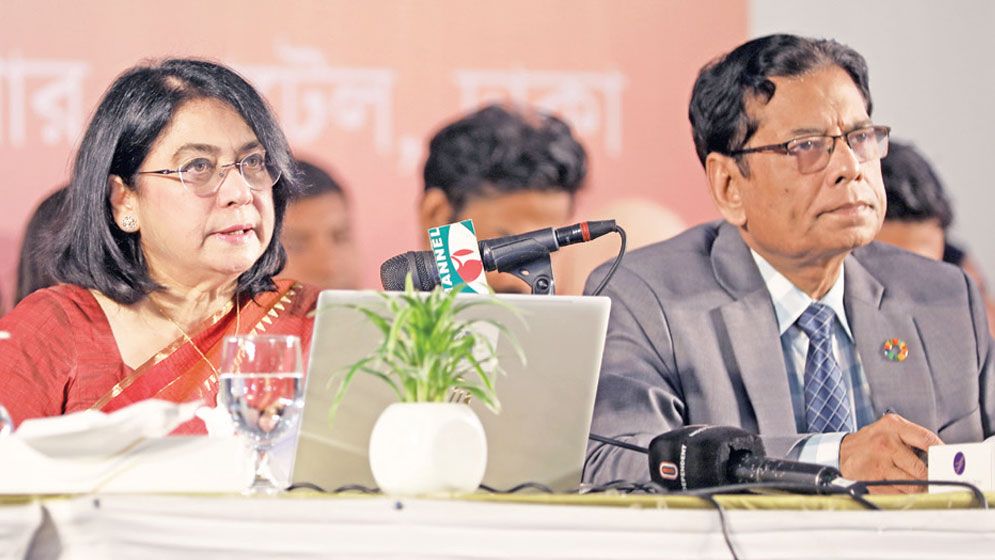
The Centre for Policy Dialogue (CPD) on Friday said implementation of the proposed national budget for fiscal year 2026-27 (FY27) will be challenging as it is built on a “weak base”, despite containing several positive policy directions.
Speaking at a media briefing titled “CPD’s Analysis of the National Budget FY2026-27” in the capital, CPD Distinguished Fellow Prof Mustafizur Rahman said the budget’s underlying assumptions on investment, private sector credit, exports, imports and GDP growth are not fully aligned with current economic realities.
Finance Minister Amir Khosru Mahmud Chowdhury unveiled the Tk9.38 lakh crore budget, the largest in the country’s history, in parliament on Thursday under the theme “Journey Towards a Democratic, Humane and Inclusive Economy.”
CPD said the budget provides the first major opportunity for the new government to demonstrate its capacity to drive economic recovery through structural reforms. However, its success will depend on implementation capacity, institutional reforms, accountability, inter-ministerial coordination and governance.
Prof Mustafizur said the budget has largely followed a traditional approach and does not fully reflect the opportunity to introduce exceptional reforms. He urged the government to strengthen institutional capacity and ensure that the implementation process reflects the BNP’s electoral commitments.
“The targets for investment, private credit, exports, imports and GDP growth suffer from structural weaknesses from the outset. This could undermine fiscal discipline,” he said.
CPD Executive Director Dr Fahmida Khatun said the budget has been proposed amid persistent economic challenges, including high inflation, slowing growth, weak private investment, sluggish job creation, revenue shortfalls, a fragile banking sector, pressure on foreign exchange reserves and energy-sector constraints.
She said reducing inflation to 7.5% would require adequate food and energy supplies alongside a realistic and effective monetary policy. Bangladesh’s annual inflation stood at 9.42% in May 2026.
Dr Fahmida warned that higher public spending could fuel inflation if it does not generate productivity gains, employment and investment. She also expressed concern over the declining share of agriculture in the Annual Development Programme (ADP), which fell from 4.7% in FY26 to 3.6% in FY27.
CPD also questioned the revenue target, which seeks 18.2% growth over the revised FY26 figure. Prof Mustafizur said achieving the target would require reforms at the National Board of Revenue (NBR), including automation, skills development and stronger institutional capacity.
He described the budget’s focus on an inclusive economy, growth-led development and environmental sustainability as positive. Social safety programmes, family cards, agricultural support and incentives for electric vehicles and renewable energy reflect these priorities, he said.
However, he warned that projections assume significant improvements in growth, inflation, revenue collection and private credit expansion within a short period. “A more realistic baseline would have made the budget more credible,” he said.
The economist noted that tax and duty reforms would not immediately boost revenue, as businesses need time to invest, expand production and generate taxable income. Without stronger revenue mobilisation, increased spending could lead to greater dependence on borrowing.
Prof Mustafizur also stressed that investment incentives alone would not attract investors unless gas, electricity and infrastructure services improve. He welcomed deregulation efforts but said they must be supported by stronger institutions.
On external debt, he said Bangladesh paid around US$7 billion in debt servicing last year and repayment pressures would rise as grace periods for major projects expire. Stronger revenue collection, digitalisation of tax administration, reduced exemptions and anti-evasion measures are therefore essential.
Addressing employment, he said the budget includes support for SMEs, start-ups, young entrepreneurs and freelancers. However, he cautioned that these initiatives may fail to deliver results without adequate institutional backing.
He also highlighted growing youth unemployment and said the budget could have outlined a clearer strategy for skills development and labour-export competitiveness. CPD further suggested introducing wage-security insurance to protect workers in the event of business failure.
Prof Mustafizur concluded that increasing budget allocations alone is not enough. “Effective spending is more important than higher spending,” he said.