




 For all latest news, follow the Daily Sun's Google News channel.


WORLD DAY AGAINST TRAFFICKING IN PERSONS TODAY
No let-up in Bangladeshis’ perilous sea crossings
Experts blame rising irregular migrations on labour market closures, lack of justice in trafficking cases

Bangladeshis have topped the list of irregular sea migrants to Italy and Greece for a second consecutive year, arriving through perilous Mediterranean routes despite repeated warnings over human trafficking and deadly crossings.
Data presented by various organisations show Bangladeshis have surpassed all previous records this year.
Experts attribute the trend to the gradual closure of labour markets abroad and a lack of justice in trafficking cases, compounded by the deception of Bangladeshi workers in Cambodian scam centres, the recruitment of others into the Russia-Ukraine war, rising trafficking of women under the guise of employment, and the trafficking of Rohingyas by boat through the Bay of Bengal.
Against this backdrop, the World Day Against Trafficking in Persons is being observed today under the theme “Trapped Behind the Scam”.
Mediterranean crossings continue unabated
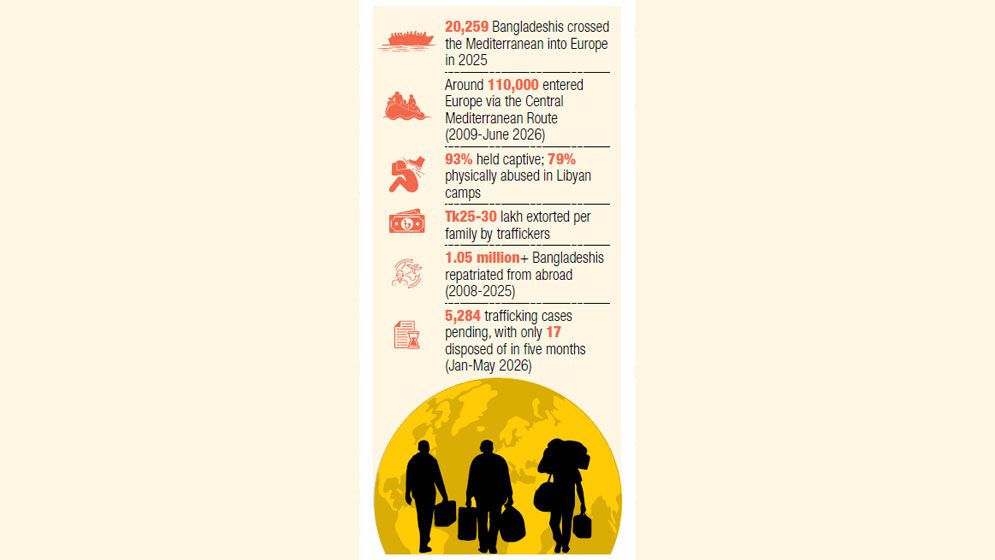
Citing data from the European Border and Coast Guard Agency (Frontex), BRAC said 20,259 Bangladeshis entered Europe by crossing the Mediterranean last year.
In the first five months of 2026 alone, 4,249 Bangladeshis entered Italy by sea, while a further 3,608 reached Greece from Libya over the same period.
Frontex figures show nearly 110,000 Bangladeshis entered Europe via the Central Mediterranean Route between 2009 and June 2026, with almost 15,000 repatriated from Libya after attempting the crossing over the past decade.
According to BRAC's Migration Programme, most undertaking these journeys are aged between 25 and 40, with people from 10 to 12 districts, including Madaripur, Shariatpur, Sylhet and Sunamganj, increasingly desperate to reach Europe by this route.
Many tortured in Libyan camps
Many Bangladeshis attempting the crossing have been detained in camps in Libya and subjected to severe physical abuse.
Traffickers have reportedly held them hostage, extorting between Tk25 lakh and Tk30 lakh from their families.
Despite these ordeals, the flow of Bangladeshis travelling to Libya in pursuit of the European dream has shown little sign of slowing.
A BRAC study tracking migrants' journeys found that most had travelled to Libya via Egypt, the United Arab Emirates or Türkiye after leaving Dhaka.
Though lured with promises of well-paid work, 75% failed to find employment and instead ended up in detention.
Of these, 93% were held captive, 79% reported physical abuse, and 69% said they lost their freedom of movement after arriving in Libya, with most also suffering inadequate access to food.
No reliable statistics, victims denied justice
There are no precise figures for how many Bangladeshis fall victim to trafficking or migrant smuggling each year.
However, sources at Dhaka's Hazrat Shahjalal International Airport say 80,000-90,000 Bangladeshis are repatriated annually after being deported from prisons or detention centres abroad – more than 1.05 million between 2008 and 2025.
Many others die attempting to migrate by sea, while countless more remain imprisoned overseas.
Although Bangladesh enacted the Prevention and Suppression of Human Trafficking Act in 2012, most cases filed under it remain unresolved, and many defendants who do face trial are acquitted.
The latest Home Affairs Ministry report shows 5,284 cases pending as of May 2026 – 1,978 under investigation and 3,306 awaiting trial.
Between January and May 2026, 71, 66, 110, 130 and 123 new cases were filed respectively each month, while only 17 were disposed of during the entire period.
No case has resulted in exemplary punishment in 2025 or so far in 2026, with most concluded cases ending in acquittal.
The government has since enacted the Human Trafficking and Migrant Smuggling Prevention and Suppression Act, 2026, bringing migrant smuggling offences under the same legal framework and retaining life imprisonment and the death penalty as maximum punishments.
The home ministry says the law will help distinguish trafficking from smuggling cases and strengthen protection for victims of sexual exploitation, forced labour, criminal exploitation and slavery.
Experts disagree, arguing that including “smuggling” in the law creates scope to blame victims, while enforcement remains lax. “According to Article 12 of the human trafficking law, these cases are non-bailable.
But we often find that police, and even sometimes judges, advise trafficking victims to settle cases through negotiation.
Ultimately, traffickers succeed in skipping the law this way,” said Ovibashi Karmi Unnayan Program (OKUP) Chairperson Shakirul Islam.
“There is a tendency among the authorities to make victims responsible. They ask victims to develop awareness – this is completely unfair.
You have to ensure justice in such cases so perpetrators don't dare repeat such deception. That is the only way to address the issue,” he added.