



 For all latest news, follow the Daily Sun's Google News channel.


Banks remain safest bet for savers
Surging remittances, high rates, and restored trust push bank deposits past Tk21.58 lakh crore

A combination of higher deposit interest rates, gradually restoring confidence, robust remittance inflows, and a scarcity of attractive alternative investments drove a sharp rise in savings.
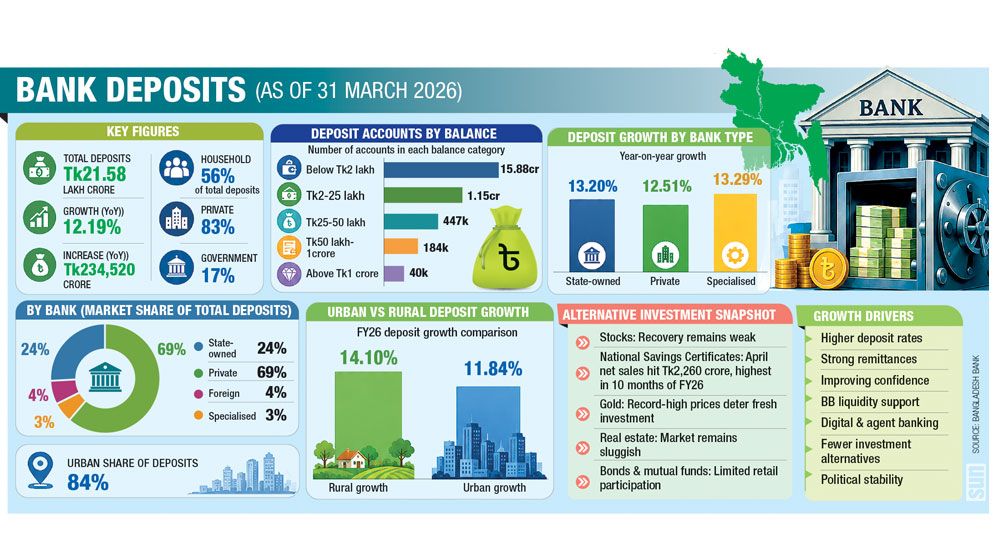
Total deposits jumped by Tk2.34 lakh crore over the past year to surpass Tk21.58 lakh crore, with individual depositors accounting for 56% of the total.
With the stock market mired in a prolonged slump and assets like gold and real estate offering uncertain returns, savers have few better places to turn.
However, economists caution that this deposit surge will only benefit the broader economy if banks successfully channel these funds into productive sectors through active lending.
According to Bangladesh Bank (BB) data, total deposits in the banking sector stood at Tk21.58 lakh crore at the end of March this year, up from Tk19.23 lakh crore a year earlier, registering annual growth of 12.19%.
Of the total deposits, 83% belong to the private sector, including 56% held by individual depositors and 27% by industries, companies, businesses and other private entities.
The remaining 17% belongs to government ministries, agencies and public institutions.
BB data also show that the number of individual bank accounts rose to 17.11 crore from 15.52 crore a year earlier.
During the same period, individual deposits increased from Tk10.62 lakh crore to Tk12.17 lakh crore.
Bankers say retail deposits have become the backbone of the banking sector because, unlike corporate deposits, they are relatively stable and less prone to sudden withdrawals.
Managing Director and CEO of Mutual Trust Bank, Syed Mahbubur Rahman, told the Daily Sun, "The banking sector had suffered from a loss of confidence following concerns surrounding several banks. The situation is now improving and deposits have started growing again."
Chairman of Bangladesh Krishi Bank Mohammad Nurul Amin said, "Individual deposits are the main driving force behind the banking sector. The higher a country's savings rate, the stronger its economy becomes. Retail deposits are stable, allowing banks to provide long-term financing and investment."
Why deposits are increasing
Sector insiders attribute the rise in deposits to several factors.
Former World Bank Lead Economist Dr Zahid Hussain attributed the rebound to recent policy moves and stabilised conditions.
"Confidence in the banking sector is gradually returning following Bangladesh Bank's reform initiatives and the board restructurings at several weak banks," Dr Hussain told the Daily Sun.
"During the political transition, many individuals and businesses withdrew cash out of uncertainty. As conditions stabilised, a significant portion of those funds flowed back into the system," he explained, adding that robust remittance inflows have also bolstered deposits.
"Additionally, Bangladesh Bank’s dollar purchases to build foreign exchange reserves injected fresh liquidity into the market, some of which returned as bank deposits," Dr. Hussain said. "With banks now offering interest rates around 11% to 12%, saving in a bank has become far more attractive than before."
Despite a year marked by banking sector irregularities, liquidity shortages, and widespread depositor concern, banks remain the preferred destination for savings in Bangladesh.
Small depositors form the backbone
BB data show that around 15.88 crore individual accounts hold deposits of less than Tk2 lakh.
Although these account holders account for the largest number of accounts, the bulk of deposits comes from middle-income savers.
About 1.15 crore account holders have deposits ranging from Tk2 lakh to Tk25 lakh, with combined savings of Tk6.73 lakh crore, representing the largest share of individual deposits.
Meanwhile, around 4.47 lakh accounts hold deposits between Tk25 lakh and Tk50 lakh, while nearly 1.84 lakh accounts have deposits ranging from more than Tk50 lakh to Tk1 crore.
Only slightly more than 40,000 accounts hold deposits exceeding Tk1 crore.
The figures indicate that Bangladesh's banking sector is largely supported by small and medium-sized savers.
Why state-owned banks are growing faster
For years, private commercial banks attracted more deposits by offering modern banking services and relatively higher interest rates.
However, that trend has shifted over the past year.
According to BB, deposits at state-owned commercial banks grew by 13.20% over the past year, compared with 12.51% growth at private commercial banks. Deposits at specialised banks increased by 13.29%.
Bankers say many depositors shifted their funds to state-owned banks after facing difficulties withdrawing deposits from several private banks and amid the government's move to merge five Shariah-based banks.
Nevertheless, private banks continue to dominate the sector, holding 69% of total deposits, while state-owned commercial banks account for 24%.
Masrur Arefin, chairman of the Association of Bankers, Bangladesh (ABB) and managing director of City Bank, said, "Stronger private banks have recorded significant deposit growth, while confidence in several state-owned banks has also improved."
Savings growing faster in rural areas
BB data show that deposit growth has been stronger in rural areas than in urban centres.
Deposits in rural areas increased by 14.10% over the past year, compared with 11.84% growth in urban areas.
However, urban areas still account for 84% of total bank deposits.
Bankers attribute the trend to the rapid expansion of agent banking, mobile banking and digital financial services, which have made banking more accessible in rural Bangladesh.
Mixed picture in alternative investments
The performance of alternative investment avenues has also encouraged people to keep their savings in banks.
After several months of sluggish performance, sales of National Savings Certificates (NSCs) have started to recover.
Net sales reached Tk2,260 crore in April, the highest monthly figure during the first 10 months of FY2025-26.
However, the stock market has yet to recover from its prolonged downturn.
Record-high gold prices have made fresh investment expensive, while the real estate market remains relatively subdued.
Mutual funds and the corporate bond market have also failed to attract broad-based retail investor confidence. As a result, banks continue to be viewed as the safest destination for savings, offering security, liquidity and relatively predictable returns.