




 For all latest news, follow the Daily Sun's Google News channel.


The morning light had not yet fully broken. In a city kitchen, 12-year-old Sufia starts her day’s work. Still sleepy-eyed, she puts water on the stove, then sweeps the house, washes dishes and prepares breakfast. While the rest of the household is just waking up, Sufia’s day is already well underway.
At the same time, another child of the same age is putting on a school uniform and packing their books. Some walk with their parents towards school, ready to sit in classrooms. But for Sufia there is no classroom – only the kitchen, the broom, the dishes and a long list of chores.
Children like Sufia are brought to the city from poor village families. Sometimes parents bring them; sometimes relatives or acquaintances place them with a household. Employers describe the arrangement as the “sirs” taking responsibility for the child’s food and shelter.
At month’s end, the money due for Sufia’s work goes not to her, but her parents in the village. It buys rice and lentils, covers her siblings’ education and medical costs or goes toward loan instalments. In a poor family’s accounts, her earnings matter. Yet those accounts record neither her absence from school, nor the playtime, friendships, exam preparation or joy of new books she has lost.
Public discussion of child labour in Bangladesh usually focuses on factories, workshops, brick kilns, construction, shops, transport or street work – places where a child is easy to identify as a labourer. Another sphere remains largely invisible behind closed doors, especially for girls.
Even when they spend long hours cooking, cleaning, washing clothes, caring for younger children or doing other household tasks, they are often not regarded as labourers.
Laila Khandaker, convenor of the child rights organisation Shishurai Shob, told the Daily Sun that domestic work needs to be included in the list of hazardous work for children. Doing so would send a clear message that employing children in domestic work is unacceptable, and would push the government, NGOs, employers, families and communities to return these children to their families and open pathways to education and skills development.
CHILD LABOUR ON THE RISE; 12 LAKH NEWLY ENGAGED
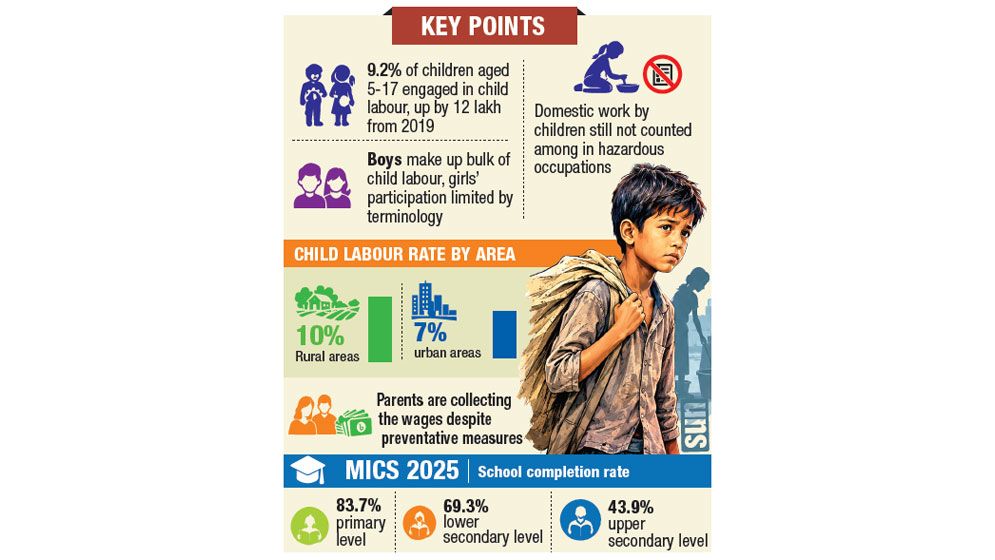
The latest national picture comes from the Multiple Indicator Cluster Survey (MICS 2025) by the Bangladesh Bureau of Statistics and UNICEF. The final report, published on 4 August, shows that 9.2 percent of children aged 5-17 are engaged in child labour. UNICEF data indicates the number has risen by about 12 lakh since 2019. The survey covered nearly 63,000 households.
Boys account for a higher share of child labour overall, yet girls’ participation in household work is significantly higher. Among 5-to-17-year olds, 7 percent are in economic activities and 2 percent perform household chores above the defined threshold. The rate is about 7 percent among children in school and rises to 18 percent among those out of school – nearly four times higher. Among the poorest households, it reaches about 14 percent against only 3 percent among the most affluent. The rate in rural areas is about 10 percent, while it is 7 percent in urban zones.
Separate recent national statistics solely on children employed as domestic workers in other people’s homes remain limited.
Md Abdus Samad Al Azad, director general of the Department of Labour, said including child domestic work in the hazardous occupations list requires evidence-based proposals and a tripartite consultation process. Discussion has increased, but the work is still not listed as hazardous for children.
AKM Ashraf Uddin, executive director of the Bangladesh Labour Foundation, noted that the informal sector employs the most child labour, making protection difficult even where laws exist. Children working as domestic help remain hard to identify and protect. Child labour is linked to poverty, limited education access and weak social protection; while visible forms have received attention, non-traditional work continues to leave many children outside the reach of rights protection.
GIRLS’ LABOUR OFTEN INVISIBLE EVEN IN STATISTICS
Experts observe that boys appear more common in child labour figures partly because much of girls’ work takes place inside homes. A boy in a garage is easily recognised as a labourer but a girl cooking, cleaning, washing and caring for children from morning till night is often described only as “helping with household work.” This language conceals the reality of her labour.
MICS 2025 counts household chores exceeding set limits – cooking, cleaning or childcare – as child labour. For children aged 5 to 14, the threshold is at least 21 hours of unpaid household services per week.
PARENTS TAKE THE WAGES
Organisations working with children say economic pressure drives the practice. A village family of five or six may have only one earner, little or no land, irregular agricultural income, medical costs, rising food prices and education expenses.
A few thousand takas per month from a child’s work become important. The child is placed with a city household that covers food and lodging; a fixed or irregular sum reaches the parents. The economic benefit of the labour does not go to the child, who has no say over its value, hours or their own future.
LAW PROHIBITS EMPLOYING UNDER 14-YEAR-OLDS
Under the Bangladesh Labour Act, a person under the age of 14 is a “child” and one aged between 14 and below 18 is an “adolescent”. Section 34 bans employing or permitting a child to work in any occupation or establishment; Section 35 bars parents or guardians from contracting employment for their children. So, parental consent does not legalise work for a child under 14 and penalties exist for such violations.
Domestic workers long lacked full protection under the labour law. However, the Bangladesh Labour (Amendment) Act 2026 newly defined “domestic workers” as a person who is employed, either through verbal or written contract, in a part-time or full-time position to perform domestic work in the employer’s home (including messes or dormitories). It also added a definition of forced or compulsory labour.
STILL NOT CLEARLY LISTED AS HAZARDOUS
Child domestic work has not been included in the government’s hazardous occupations list. In the first six months of 2026 alone, at least six cases of abuse of domestic workers – allegations including murder, rape, torture, physical assault and excessive working hours – drew public attention. The ILO links child domestic work to the worst forms of child labour under Convention No.182 and Recommendation No.190 when it harms health, safety or moral development.
Fresh discussion on listing it as hazardous began in 2026. The Labour Department’s director general said any move must follow the prescribed legal and consultative process, with evidence-based proposals going to the Ministry of Labour and Employment through tripartite consultation. Abdullah Al Mamun, director of Child Protection and Child Rights Governance, stressed that publishing reports is not enough; practical steps based on the problems identified are required. The earlier target of eliminating child labour by 2025 proved difficult under prevailing conditions.
DISCONNECTION FROM EDUCATION IS A MAJOR CONSEQUENCE
Experts identify separation from education as one of the greatest harms. Article 17 of the Constitution directs the state to ensure free and compulsory education up to a level set by law. Yet, MICS 2025 data show the adjusted net attendance rate falling from 85 percent at primary age to 60.1 per cent at lower secondary and 50.8 percent at upper secondary, with 33.9 percent of upper-secondary-age children out of school. Completion rates drop from 83.7 percent at primary to 69.3 percent at lower secondary and only 43.9 percent at upper secondary.
Economic hardship remains a key driver. UNICEF and ILO analyses link child labour to poverty, gaps in social protection and limited education access. The 2025 ILO-UNICEF global report estimated that in 2024, about 138 million children worldwide were in engaged child labour, of which some 54 million were doing hazardous work.
Recommended Stories