




 For all latest news, follow the Daily Sun's Google News channel.


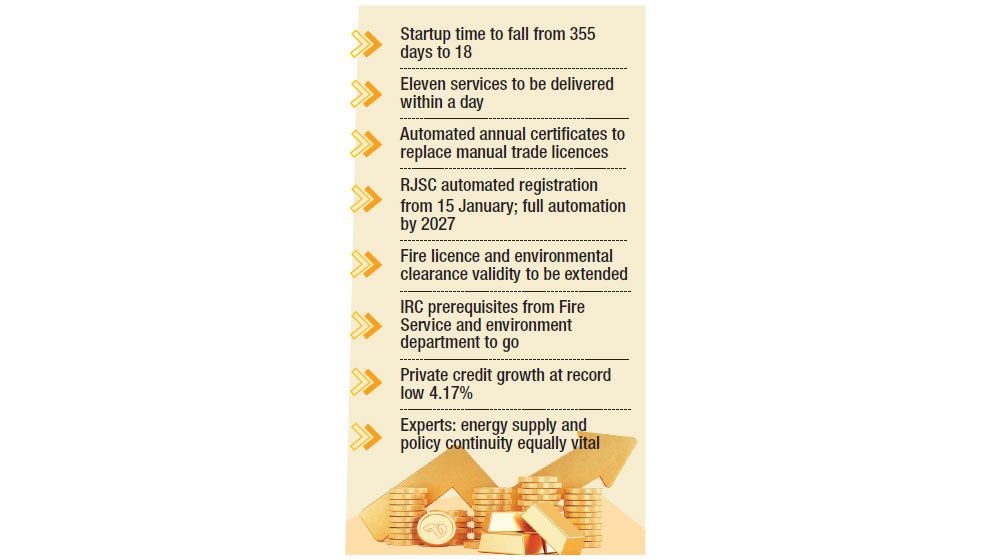
The government has drawn up a reform plan to revive stalled investment, aiming to cut the time needed to start a business from as long as 355 days to 18 and to deliver 11 of the 12 required services and approvals within a single day.
The move comes as private sector credit growth fell to a record low of 4.17% at the end of September, Bangladesh Bank data show, and has stayed below 5% for seven consecutive months. Many industrial units have shut down or are running far below capacity because of severe gas and electricity shortages. Banks, meanwhile, are cautious about new lending amid rising non-performing loans and are putting excess liquidity into government securities instead.
The plan was presented at the second meeting of a committee on simplifying the setting up of industrial establishments, chaired by Commerce and Industries Minister Khandakar Abdul Muktadir.
The government’s ultimate goal is to complete the whole process within 14 days, but a presentation by Invest Bangladesh (IB) outlined an interim target of 18 days.
To get there, the government plans to reduce prerequisites, allow multiple applications to be processed simultaneously and introduce a single digital platform for business registration and related approvals.
A commerce ministry official at the meeting said it currently takes nearly a year to go from planning a factory to opening a letter of credit (LC).
“Our goal is to ensure that a new business can be started within 14 days before the next budget,” the official said.
Eleven services in a day
According to the presentation, the 11 services targeted for delivery within a day are name clearance, opening a non-operating bank account, company registration with the Registrar of Joint Stock Companies and Firms (RJSC), trade licence, Taxpayer Identification Number (TIN), a regular bank account, fire licence, environmental clearance, building plan approval, Import Registration Certificate (IRC) and Business Identification Number (BIN) registration. Obtaining these from government agencies currently takes between 167 and 325 days.
The IRC is the exception, as it requires an IB recommendation. IB currently takes 10 days to send the recommendation to the Office of the Chief Controller of Imports and Exports (CCI&E), and the new roadmap cuts this to seven. The CCI&E will then issue the IRC within a day, against the current 20 days.
Automated certificates to replace trade licences
The government plans to replace manual trade licences with automated annual Business Registration Certificates (BRCs), issued instantly through a central digital portal. Businesses currently obtain trade licences manually from city corporations, municipalities or union parishads, a process taking between seven and 30 days.
Under the proposed system, applicants will receive a BRC immediately after paying the fees online, with no pre-inspection or manual approval. Fees will remain the same as for trade licences, and online payments will go automatically to the bank accounts of the local government institutions concerned.
The change will need policy-level coordination at the prime minister’s level. The regulations of banks and revenue authorities will also have to be updated to recognise the BRC for applications for BIN, IRC and Export Registration Certificate (ERC).
RJSC automation
The RJSC told the meeting that pilot testing had begun on a new platform for automated name clearance and company registration within a day. Investors are expected to receive these services from 15 January next year. The agency has also prepared an action plan and roadmap to deliver 54 post-registration services more quickly, with a target of fully automating all its services by 15 January 2027. It is also working on amendments to the Companies Act, 1994, and on simplifying the Memorandum of Association in line with international benchmarks. Its portal will later be integrated with BanglaBiz.
Fire licence and environmental clearance
The government plans to extend the validity of fire licences from one year to three, easing annual renewals. The Fire Service and Civil Defence Directorate has developed a digital platform for issuing no-objection certificates and fire licences. The agency sought six months to integrate it with BanglaBiz, but the committee told it to finish by November.
At present, businesses must submit two separate applications, and Fire Service officials make multiple field visits. The process takes around 90 days. The presentation cited international practice: in Singapore, private engineers issue three-year fire licences within three days and inspect premises annually. In India, licences are valid for three years and take about three weeks. Vietnam has no separate fire licence, as fire safety is examined during building plan approval, completed within six days.
Environmental clearances will similarly be extended from one year to three or five years, depending on the industry category. Public hearings will be held entirely online. The Department of Environment will add sector-specific experts to its technical review committee and accept test results from laboratories approved by the Bangladesh Accreditation Board (BAB) and public universities.
The government is also amending the Import Registration Order (IRO) to speed up IRCs and ERCs. Companies currently need final approvals from the Fire Service and the Department of Environment before getting an IRC, and the amendments would remove these prerequisites. The entire IRC process will also be automated and digitised.
Experts’ caution
Zahid Hossain, former lead economist of the World Bank’s Dhaka Office, said simplifying the startup process was a positive step for the investment climate, but faster licences and approvals alone would not be enough.
“Ensuring uninterrupted gas and electricity supplies, policy continuity, discipline in the financial sector and restoring business confidence are equally important,” he said. “Otherwise, the target of starting a business within 14 or 18 days will not be sufficient to accelerate investment.”
Business leaders said lengthy procedures for licences, approvals and clearances were among the main barriers to investment. They said the plan would cut both time and costs for entrepreneurs if implemented, but added that uninterrupted gas and electricity, easier bank loans and policy continuity must also be ensured.
“Visible improvements in these areas will help increase new investment and employment,” they said.