


 For all latest news, follow the Daily Sun's Google News channel.


Equality denied: Pakistan’s minorities still face discrimination
Daily Sun Report, Dhaka
Published: 20 Oct 2026, 02:48 PM
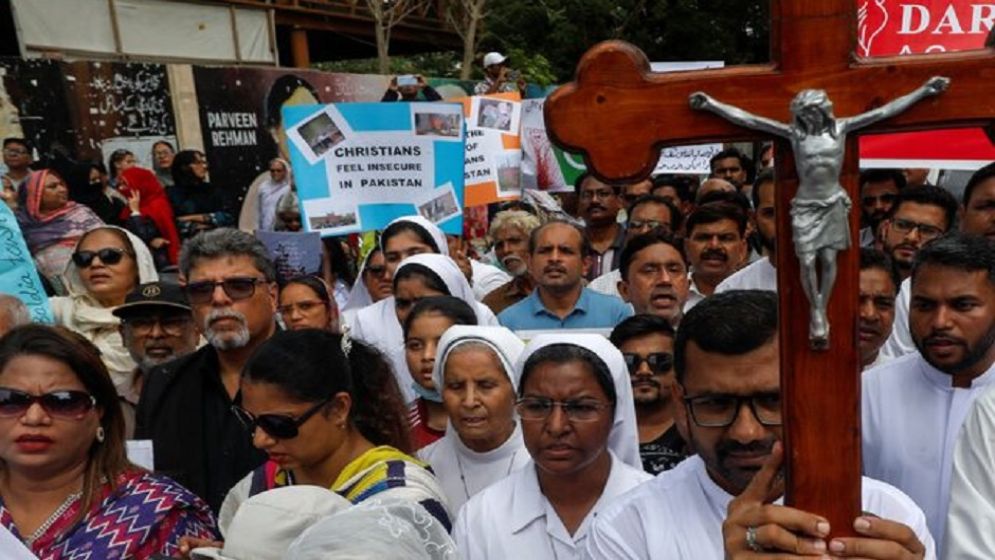
Members of the Christian community chant slogans as they gather to condemn the attacks on churches and houses in Jaranwala town of Faisalabad, during a protest in Karachi, Pakistan 18 August, 2023. REUTERS
Pakistan continues to fall short of its promise of equality for religious minorities, with hate speech, forced marriages, discrimination and weak law enforcement persisting despite recent legal reforms, according to a new report by the Human Rights Commission of Pakistan (HRCP).
The report, titled Sanctuary Denied: Freedom of Religion or Belief in 2025/26, was released last week. The HRCP’s seventh annual review of religious freedom welcomes the passage of the National Commission for Minorities Act 2025 and child marriage restraint laws in Balochistan and Punjab. However, it warns that progress on paper has yet to translate into meaningful protection for minority communities.
The National Commission for Minorities Act remains unimplemented months after its passage, while the report urges Khyber Pakhtunkhwa to raise the minimum marriageable age to 18.
During the review period, blasphemy laws continued to be weaponised, hate speech against minorities became increasingly normalised, and girls from minority communities remained vulnerable to abduction and forced marriage. Minority groups also faced shrinking employment opportunities despite a five per cent quota in government jobs, while their concerns received little attention in mainstream media.
Minority rights linked to wider social problems
The report highlights how violations of minority rights are closely linked to broader problems that Pakistan has struggled to address, including poverty, gender discrimination, violence against women and the exploitation and abuse of children.
The abduction and forced conversion of girls from minority communities expose serious failures in protecting not only religious minorities but also women and children. The plight of sanitation workers, meanwhile, shows how discriminatory recruitment practices can trap people in poverty and force them into dangerous jobs with little protection.
The report also raises concerns about the conduct of law enforcement agencies. In several cases, police have shown little willingness to protect minorities facing discrimination, including incidents in which mobs attacked minority places of worship or authorities failed to respond promptly to reports of abducted minority girls.
Such failures raise serious questions about the state's commitment to enforcing the laws intended to protect vulnerable communities.
Laws alone cannot guarantee equality
Legislation is an important step towards protecting minority rights, but its effectiveness depends on proper implementation. The failure to operationalise the National Commission for Minorities Act months after its passage illustrates the gap between official commitments and action on the ground.
The persistence of discrimination also points to a wider social climate in which hostility towards minorities has become increasingly accepted. As the report notes, the normalisation of hate speech creates an environment in which intimidation and violence can flourish.
Protecting minorities, therefore, requires more than passing laws and introducing policies. It also demands a concerted effort to challenge the attitudes and narratives that fuel religious hatred and discrimination, while holding those responsible to account.
The HRCP has called for legal action against all incitements to violence, particularly on social media, as well as mandatory training for law enforcement personnel on offences related to freedom of religion or belief.
These measures could help strengthen institutional responses to discrimination, but their success will depend on the willingness of authorities to act consistently and impartially.
Pakistan has taken some steps towards improving legal protections for minorities. Yet, without effective enforcement and a broader shift in public attitudes, these reforms risk remaining little more than promises.
The question is no longer simply whether the country can introduce the right laws, but whether its institutions and society are prepared to uphold the principle of equality. Given the slow pace of implementation, how long will it take for that principle to become a reality?
Source: The News, Pakistan